


The Marker, Gili Melnitsky, 02.12.2020
The Planning and Construction Subcommittee of the Tel Aviv-Yafo Municipality last week discussed behind closed doors the "Update of the Municipal Outline Plan" Cell / 5000. The "update" is "in fact a statutory process of re-approving a plan" - the municipality admits in an internal document distributed to committee members, and the latest plan to be promoted in the coming months is expected to completely replace the existing plan. This was approved after a lengthy process in 2016, and it actually sets out the urban planning vision by 2025.
The main reasons for reopening the plan relate to changes in the national and metropolitan planning level, and affect urban planning policy: development of mass transit systems including NOP 70 - the supplementary plan to the metro project; light rail system; repeal of NOP 38 ; The distress of sewage absorption and municipal drainage, etc. - all of these require changes and adjustments in the municipal plan.
The plan treats the planned metro lines in the city as a given situation and leaves no room for the question marks that are trying to flood Miri Regev. In doing so, Huldai obliges the government to invest heavily in the infrastructure that will serve the city.
At the same time, working assumptions adopted by the municipality in recent years, including a significant reduction in the use of private vehicles and increased walking and bicycle traffic in the city and attempts to strengthen and expand public areas in accordance with residents' requirements and increase density, require it to comply with municipal parking regulations. The corona crisis, which has undermined a number of job discounts regarding the amount of employment space, also requires rethinking on the part of the municipality, which wants to maintain its income from businesses.
- Advertising -
The municipality intends to act to exhaust and increase the real planning inventory and discuss the building rights granted in relation to the one presented by the master plan for 2025. The current plan T / 5000, presents goals and planning of residential areas that constitute about 75% of the real urban potential. -65% of the real potential.
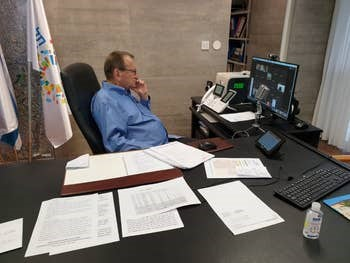
Tel Aviv Mayor Ron Huldai Photo: Courtesy of Tel Aviv Municipality
Last week, the first meeting was held in the presence of members of the municipal planning and construction committee, alongside the city’s legal counsel. At this stage, senior municipal officials are beginning a process of reformulating goals and issues that will guide the planning and development policy of Tel Aviv-Yafo. In the coming weeks, groups of stakeholders will be invited: including the business sector, municipal companies, government bodies, third sector, residents' committees, municipal and external planning teams - to discuss key planning issues and solution directions.
Fear among residents
The main issues that have come to the fore of the committee - which in the meantime chooses to hold talks in small circles and not in the presence of the residents - are: strengthening urban nature and urban public areas; Expanding guidelines to encourage urban renewal, distinguishing between different areas of the city and emphasizing social and community aspects that will prevent gentrification; Increasing the variety of urban housing - small apartments and shared housing for example; Preparation of infrastructure for advanced transportation solutions including electric vehicles and skimmers as a transport tool; Residential integration in urban business centers; Development of the uses of the underground and engagement with renewable energies in the developing residential neighborhoods. In addition, pilots in the municipality are currently working on technological development in order to read 3D city plans.
The Tel Aviv-Yafo District Planning and Building Committee will approve the new municipal master plan, and according to municipal planning officials, the local committee intends to bring the update documents to the City Council and District Committee for approval by the end of 2021. . The intention is to reach the deposit of the plan in mid-2022 and its approval in early 2023.
Residents in the city have raised concerns that the outline for sharing and informing the public is unclear and it is currently unclear whether residents' voices will be heard when the principles of the plan have already become a fact, and they will stay away from decision-making processes.
The Tel Aviv Municipality explains that "the first discussion in updating the plan was an internal discussion in order to hear the committee members about the working directions and a protocol will be uploaded to the municipal website soon. The rest of the discussions will be open to the general public, according to the local committee's decision . The space of uncertainty regarding planning in the city and created a broad common denominator, while breaking through and assuming a new planning language and innovative planning tools in order to achieve its goals and serve urban planning.Therefore, the Tel Aviv Local Committee and Municipality intend to continue working with the plan A structure and methodology that underlies the current plan.
"However, after four years of working with the plan, and seven years since its deposit, there are changes, updates and corrections required. In terms of the statutory procedure, it is indeed a move to approve a new plan. But in terms of planning and substance For the purpose of accuracy, updating and adjusting the urban outline plan to the changing reality and with the aim of keeping it up-to-date, innovative and relevant. "