



Calcalist, Dror Marmor, 01.12.20
Despite the corona, unemployment and economic uncertainty, the plethora of data flowing in recent weeks and months from the residential real estate industry in Israel indicates high demand and the return of buyers, who have largely despaired of government promises to cut prices. The apartments; One week ago, the Bank of Israel presented record data on mortgages taken by Israelis from January to October, totaling NIS 63 billion (14% more than in the corresponding period last year); And the Central Bureau of Statistics recently reported an impressive rate of new apartment sales by developers since the beginning of the year.
From January to September, before the CBS data, 27,202 new dwellings were sold in Israel, 15% more compared to the corresponding period last year. 10,137 new dwellings were sold in the third quarter, an increase of 25% compared to the corresponding quarter last year. The strongest. According to the tax authority, 10,310 new apartments were sold in the third quarter of this year.
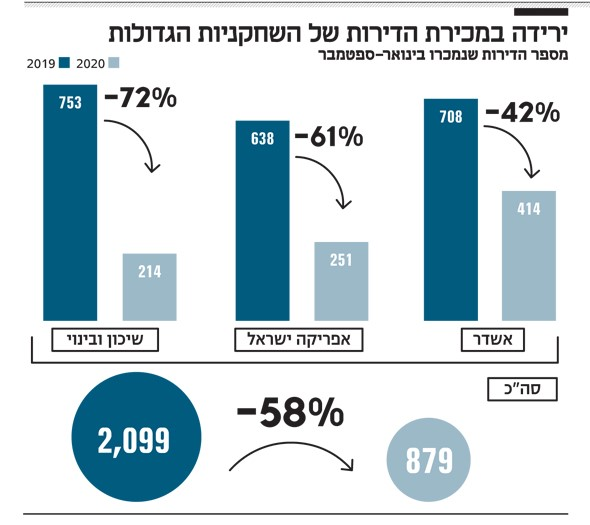
Nevertheless, the numbers presented in recent days by the real estate lions - the large and old companies Shikun VeBinui, Ashdar and Africa Residences - indicate a sharp drop in sales since the beginning of the year, especially in the third quarter.
According to reports presented yesterday by Shikun VeBinui, since the beginning of the year it has sold 214 apartments in Israel, compared to 753 apartments in the corresponding period last year. Africa Residence from the Africa Israel Group sold 251 apartments, compared to 638 in the corresponding period. In all, the three largest companies have sold 879 apartments since the beginning of the year, a decrease of 58% compared to the same period last year.
In a quarterly summary, Shikun VeBinui showed a slight increase in the third quarter - 87 apartments compared to only 80 in the corresponding quarter of 2019. Africa Residential sold 112 apartments compared to 406 last year, and Ashdar sold 177 apartments compared to 303 apartments in the third quarter of 2019.
Why exactly did the big companies, contrary to the well-known saying "when the waves get stronger the stronger ones are revealed", weaken so much in the Corona period? Before drawing conclusions about the first cracks in the big companies, it may be that the advantage of size is that it has enabled them not to be flexible about conditions and prices in this year of economic crisis. The fact that they were not hit in the revenue line in the financial statements, a result of sales from previous years, allowed them to take a deep breath and wait along with the market.
In addition, large companies are often in a hurry to sell many apartments "on paper". Therefore, in view of the stagnation in the supply of available land and the supply of new projects in the past year - partly due to a sharp decline in land marketing by the state and approval of plans in the various committees - they did not have so many stocks left to continue selling at previous years. Beyond that, in Africa Israel and Ashdar point to price-per-tenant sales that have jumped the 2019 figures, while those projects are gradually disappearing from the market.
According to Arnon Friedman, CEO of Ashdar, the low figures this year are a result of availability at the start of construction and new apartments, "and if the authorities had not delayed us, then probably the volume of sales this year would have exceeded last year."
In the financial reports, Ashdar noted that Corona and economic uncertainty are also responsible for the decline in sales, "and the company estimates that a slowdown in the rate of apartment sales could lead to a drop in prices in the short term, whether influenced by homeowners interested in selling their apartment." At lower prices than before. "However," in the medium term the company expects the gap between the supply of apartments and the demand for apartments to increase, especially in areas of demand, both due to a decrease in construction starts and an increase in population, an increase in immigration from abroad and a return to Israel. "