



Calcalist, Dov Cohen 02.12.20
In collaboration with the real estate arena system
Earlier this week, the Interior Ministry issued a memorandum of law containing new rules for strengthening buildings against earthquakes, in what may be the law that will replace TMA 38, which will expire in less than two years, in October 2022.
While NOP 38 is a nationwide plan that dictates to local municipal committees rules for strengthening earthquake structures, the proposed amendment to the law changes this and gives municipalities the authority to approve such plans at their discretion, taking into account their planning needs. Approve a plan for the demolition and reconstruction of a building - even if a permit was granted for its construction before January 1980.
The new plan will make it possible to increase the built-up area by up to 350% of the total built-up areas on the ground, with only the original built-up areas of the building included in the calculation, including construction added until January 1, 2000. All this provided that the reinforced structure is at least two stories At least two housing units. The local authority may add to the new building or buildings an additional built-up area for public use which will be transferred to its ownership - at a rate of up to 15% of the total building areas allowed in demolition projects, or up to 10% in reinforcement projects.
The local committee was also amended to have the authority to reduce parking spaces in residential buildings in demolition and reconstruction projects, in order to preserve their profitability and allow them to materialize.
In addition and in order to shorten the schedules for the implementation of plans, the Minister of the Interior will be given the authority to prescribe provisions in regulations, according to which a decision of a local committee to approve a plan will also be considered a decision to grant a building permit. This is while today, after the approval of the master plan, the local committee must be asked for a building permit in a procedure that sometimes lasts a year or more.
In addition, according to the proposed law, a local committee that does not submit to the district committee a general plan for urban renewal within three years from the date of entry into force of the law, its powers to approve urban renewal plans will expire, regarding plans that have not yet been decided.
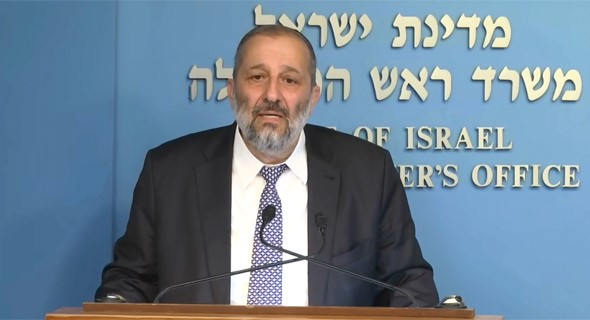
Minister of the Interior, Aryeh Deri Photo: Gil Yohanan
A simple equation
Despite the great importance of the proposed law, which is almost undisputed among activists in the field of urban renewal, there are also those who identify failures in it. Adv. Orit Rimon, a partner in the firm of Dan Bar-El & Co., a law firm and notary, says that "one of the main problems in the proposed law is the authority given to local authorities to expropriate land in residential buildings for public needs without restrictions and / or regulated regulations, which May cause local authorities to expropriate many areas and appropriate these areas for themselves without first examining the needs of the neighborhood.
"Also, the definition of public use of building land in demolition and construction projects is too broad and may lead to opposition on the part of apartment owners. Although the goal is worthy, one should honestly ask how many tenants will agree to promote a project in their building." S.
"The nature of the uses must therefore be defined by law, and limited to certain uses that do not significantly harm the quality of life of the tenants or the value of their properties. Otherwise it is an injury that few homeowners would be willing to agree to."
According to Rimon, the transfer of authority to local authorities to approve additional rights under detailed plans in urban renewal projects is a right and proper step: "Without the participation of local authorities there will be no urban renewal, as they know better than any national institution what their planning needs are. In order to create planning certainty among those involved in the craft, local authorities must create clear and uniform rules in a policy document, regarding the scope of rights and public areas they intend to expropriate in each of the neighborhoods and / or buildings in the city,
"It is important that without clear and uniform rules, including regarding the expropriation of rights, developers will find it difficult to promote projects of this kind.

Adv. Orit Rimon Photo: Reuven Kopiczynski
Another dramatic issue in the law memorandum is the abolition of the institution of relief by local authorities. Today, local committees may approve additional building rights and increase the number of building units by up to 30% of the number of units in the plan. This situation has created a route that bypasses planning and almost automatic requests from developers for approval of additional construction and increasing the number of units. As a result, the original plan becomes redundant, the procedure for issuing a building permit becomes cumbersome and the construction process is delayed for months.
According to Rimon, "At the planning level, this is a worthy step, because it creates planning certainty and reduces the time period for issuing building permits - a critical thing in the field of urban renewal. But on the other hand, the issue of economic feasibility and planning flexibility must be taken into account. It was the units, as part of the facilitation, that enabled the project to be implemented financially.
It should also be remembered that in recent years the authorities have already estimated in advance that developers will seek relief, as a matter of routine, so they have often approved a small amount of housing units. They also understand that in many projects the equation is simple: if there are no facilitations - the project has no economic justification.
"Another important aspect is the planning flexibility - the relief is intended, among other things, to allow the plan to be adapted to the specific plot data and to the changing reality in the field. This goal must be preserved.
"Therefore, the limitation on the request for relief should be subject to two things," Rimon concludes: And the second is that they will allow planning flexibility in exceptional cases, for example when there is a single lot without the extension of the building lines, it will not be possible to build the scope of the rights and units in the plan. "
"Also to complete the amendment, amendments must be made to the Real Estate Tax Law and the VAT Law, to ensure that the exemptions from praise tax, purchase tax and VAT construction services will apply to apartment owners even in the case of a detailed plan of the type mentioned in the law memorandum.