



Globes, Eric Mirowski, Guy Nardi, 12.05.2020
After a two-month stagnation, the Israeli market is taking its first steps outside the home. Some employees return to their workplaces from the USSR, and even get interested in apartments for sale or for rent. In new deals.
Banks also report interest in new mortgages and a decline in applications for deferral of existing mortgages. Does this interest indicate a gradual return to routine or merely attempts to return to business as usual? As far as real estate and mortgage markets are concerned, both are very far from the pre-Corona era, and the same interest that people find in apartments and mortgages can quickly fade away if a negative change in situation occurs.
Some of the bank's clients have asked for loans to be rejected
1. The supply of apartments has increased, but the number of transactions has decreased
According to data from Hand 2 website, the number of new ads per day of apartments for sale in mid-February averaged 674 per week and only 85, during the peak period (11.4.20-5.4.20). Last week, the number of new ads was 723.
The average number of new apartments for rent per day in mid-February was 801 per week, during the crisis peak of 373, and last week 1,333 deals.
Does the experience indicate greater interest or, indeed, greater supply due to the crisis? There is still not enough data to clarify the image.
Apartment prices for sale reflect only a minimal decrease. The average price of a 4-room apartment for sale in Tel Aviv in the months preceding the Corona crisis was NIS 2,301,505 and in the last two months (March, April) NIS 2,287,852. That is, a decrease of only 0.6%. In Haifa, there is a reverse trend. The price of an apartment in the period prior to Corona was NIS 1,477,774 and in the last two months NIS 1,497,527 - an increase of 1.3%. There is no change in Be'er Sheva. The average price of a 4-room apartment before and during the Corona period has not changed and stands at about NIS 1,168,170.
There are also minor changes in rental prices: The average rent of a 3-room apartment in Tel Aviv in the pre-Corona period was NIS 7,170 and in March and April NIS 7,009. The price in Haifa was NIS 2,965 and in the Corona NIS 3,004. In Kiryat Motzkin, the price was NIS 2,885 and in the Corona period NIS 2,984. The price in Eilat was NIS 3,562.
It should be made clear that the prices in the ads are only requested and not the prices of the transactions made, so they are usually higher than the actual transaction price.
The number of real estate transactions carried out in March-April has yet to be published. Because according to the tax authority, the decrease in the number of transactions was reflected by 30% in March, and by an even larger number in April.
Speaking to Itzik Levy, chairman of the Realtors Association in Israel, he says that for the realtors, the situation is exceptional and that even if there is interest in the sale or rental of apartments, as is evident from Yad 2 website data, many are afraid to bring foreign homes into their homes. The National Crisis Exit Strategy and Invented the "Purple Character of the Bureau of Real Estate Brokers," which is based on the Ministry of Health's demands for a return to business. A bureau member who would like to receive the bureau's purple letter signs a pledge to the bureau that he pledges to keep Maximum protection for yourself, property owners and buyers / renters.
Index-linked mortgage interest rates went back a year
2. Mortgage Rejection: References to banks have diminished
"The mortgage market in Israel behaves similar to the Corona curve. When it went up steeply - the number of mortgage deferral requests went up steeply; now that the curve has flattened out - calls for rejections have flattened out, and from thousands of inquiries a day, we've reached a few dozen." This is how a senior banker describes what is happening in this market in recent times. Concurrent with the steep decline in mortgage repayment, bankers report that they are encountering a hesitant return of home buyers to the market.
The "Corona Panic" is expressed in several aspects. First, last March, he recorded the all-time monthly record of taking mortgages - NIS 8.7 billion. Part of that record was attributed to the high demand in the market prior to the Corona epidemic, and another, which came to light in the second half of March, came from home buyers who were pre-empting their loans for fear of raising interest rates because of the plague.
It is estimated that in April the numbers will be much lower in March, but the lows of the depleted housing market, which took place in the shadow of the epidemic, will probably be recorded in May-June.
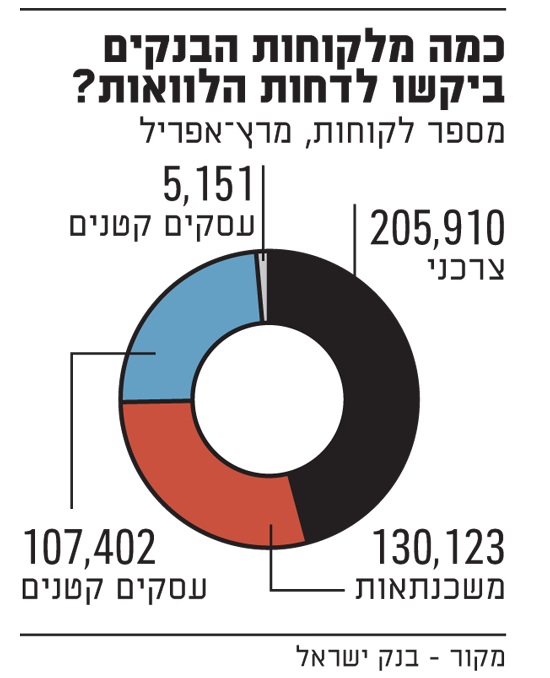
Another aspect of the mortgage market is the possibility given to households and businesses to deal with the situation, through the repayment of loan payments. From the beginning of the crisis until the end of April, the banks declined loans to 448,676 customers in all segments of operations, for a total of NIS 5.2 billion; Among the customers who received a rejection, there are 130,213 customers who received a repayment of NIS 1.8 billion in mortgage payments.
The original loan repayment period was three months. Last weekend, the Bank of Israel announced that the deferral of mortgage payments would be extended to six months.
Extending the freeze date raises the possibility that during June there will be households seeking to extend the original freeze given to them for another three months, thus fulfilling the Bank of Israel's latest guidelines. The senior officials estimate that the size of this wave of inquiries is largely dependent on the state of the Corona and the return of the economy to routine and employment.
3. Interest rates: increase to decrease
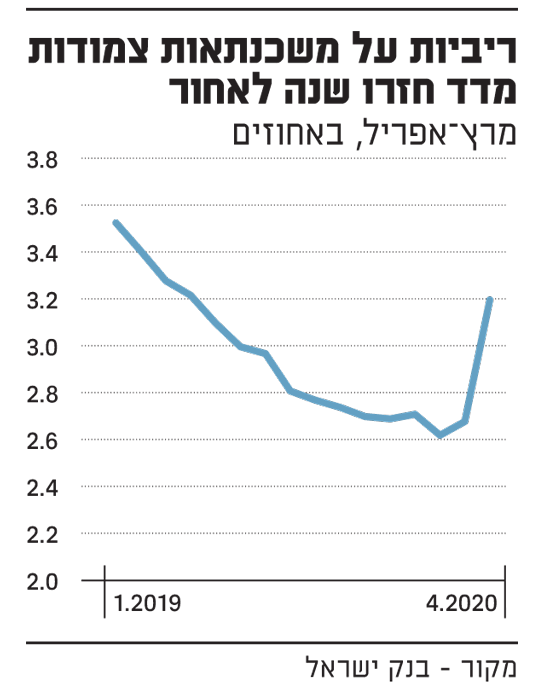
A third aspect of the impact of the corona on the mortgage market is reflected in interest rates. The average interest rate on her mortgage in April rose more than half a percent. The most significant segment was fixed interest rates (fixed and unlinked). The Bank of Israel data shows that the average interest rate on index-linked mortgages rose from 2.62% in February to 3.2% in April.
Now interest rates are also falling. Meir Vader, CEO of mortgage consulting firm Vader Mortgage, says new mortgage rates have dropped significantly since late April and early May, reaching unlinked fixed interest rates of about 3.3% to 3.6% for a 25-year period. It returned to a 0.6% spread, so that the total interest rate of the prime component is currently about 1%, and today the total interest charged today is slightly higher than the February rate.
4. Mortgage Demand: Especially with the price winners per mortgagee
Recently, there have been budgets of customer interest in new mortgages. "Purchasers who were on the fence during the Corona period returned to the purchase lot and demand became more rigid and the amount of interested parties reached about 80% of the demand that was before the Corona period," Vader estimates. According to him, the mortgage banks have been opened and the ability to negotiate with the banks on the terms of the mortgage has also increased and the banks are fighting for every execution of its mortgage and are even increasing to advertise it in all possible media.
"Right now we see 2 main segments of people who want to redeem mortgages: the largest one is the public of mortgage winners, most of whom have decided not to give up their won apartments; The property. Housing enhancers, on the other hand, are freezing, "says one of the bankers.