


The Marker, Gili Melnicki, 12.05.2020
The Corona epidemic has caused an 80% jump in the number of urban renewal and construction companies that are facing financial difficulties - according to CofaceBdi business information company.
The investigation shows that since the crisis began and the imposition of restrictions on the economy in March, 234 new companies were added to some 300 companies that were still in difficulties before the crisis - due to various problems of non-compliance with payment obligations towards suppliers, liquidity difficulties, high leverage, limited accounts, checks Recurring, difficulties in finding financing bodies and the like. Of the roughly 1,400 municipal renewal companies, more than 530 companies are likely to find themselves on the verge of collapse in the coming months, according to BDI.
 Glory Yanai Photo: Zvika Goldstein
These figures come from the growth in the unemployment rate, the tightening of lending conditions by banks and funders of projects in the industry and the general uncertainty in the real estate market regarding housing prices and purchasing power. "We have witnessed an unusual increase in the number of companies in the last few weeks," explains Fame Yanai, CEO "A joint venture with CofaceBdi. "The Corona epidemic and the steps taken by the government have caused the planning procedures to be halted, the expenses increased, there was further difficulty in obtaining credit from the financing bodies (especially for the small companies) and the sales of the new apartments in projects, which should finance the project and be a condition for financing by the funding bodies - were stopped."
Yanai explains that part of the severe damage to this industry is related to the nature of the players in the field , and in particular to inexperienced entrepreneurs without financial strength and sufficient equity, which Corona emphasized their weakness. According to Yanai, "In the last few years, hundreds of entrepreneurs have entered the field of urban renewal - and in particular to initiate projects in the area of Tama 38 - some of them young, inexperienced entrepreneurs. Their entry into the industry was made almost without barriers to entry, as the initial stages of the project (which include tenant signing and planning) have expenses that do not require high equity. Problems start when you get the permit, funding and execution step. At these points, even before the Corona crisis, problems arise for small companies with no financial backing and experience, and some of them face difficulties that deepen during this period. "
Small entrepreneurs are trying to bail out the big ones
The Corona has changed the rules of the game in the last two months, and perhaps far beyond. The restriction on crowdsourcing and social distance has made tenant conferences, stages of the law required by tenants to decide on office holders, contractor and plan, and in fact determine the future of the project - impossible. Contract signing has also been rejected in many cases, and in the resulting situation, many entrepreneurs are hesitant to start new projects.
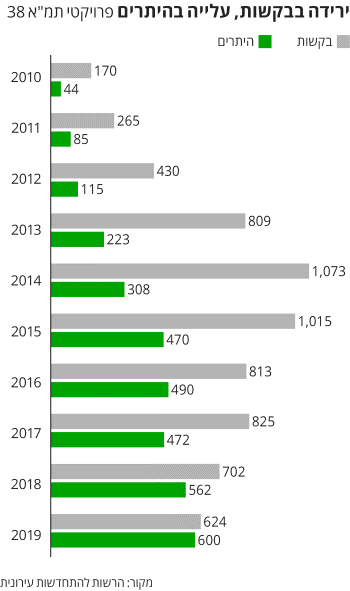
"Uncertainty is felt throughout the market - but for TAMA 38, it is a quiet death," claims Attorney Yishai Izkowitz, head of real estate department and partner at Agmon & Rosenberg Cohen & Co.'s office. "A38 I do not see any entrepreneur starting a project these days. A responsible entrepreneur who arrives on January 1, 2021 without 80% of tenants' signatures and advanced planning procedures - will throw the project and take no risk. In this situation it will be much more difficult to reach this point. We are witnessing small entrepreneurs trying to sell projects, or finding partners that will be used financially for the project in case they fail to sell apartments and bring them to fruition. And recalculate, even if it means bringing in an investor or getting out of the project. "
Yossi Hasson, CEO of MYTOWN (Structural Strengthening Company), says - like larger companies, some are traded on the stock exchange and operating in urban renewal - that in recent weeks he has received small requests for credit or financial crunch in the project, and is seeking bailouts in the form of partnership proposals or Purchase Requests.
 Yossi Hasson Photo: Courtesy of Chai Company
"Many of the SMEs, which have up to 10 projects at various stages and use of non-bank financing, loans and financing from them - are facing shock," says Hasson. "Those who do not enter well into the crisis will not hold up. We will see many more crashes in the next two months. We must understand: In our industry, the crisis is not only not over - it has not started yet. The severe economic plagues are still ahead of us. Anyone who is heavily leveraged may find himself in trouble. Anyone who relies on extra-bank financing is more expensive.
"Entrepreneurs who rely on non-bank financing also suffer from conditions that make the project, and in times of crisis, they begin to intervene in the project, which increases instability. These are entities that any small change in thought can kill the project. Distribute money in the present. If the Tama 38 project puts in NIS 5 million and now there is a 10% drop in real estate prices - the profitability of the project can be cut in a second. "
Omar Guggenheim, director of Ashder Boutique, which deals with urban renewal, says the crisis has raised the number of inquiries from small companies to form partnerships. "Referrals have increased and we recognize quite a few opportunities. I guess the Corona is emphasizing the importance of stability and professionalism. Companies like Ashdar and Ashtrom with financial strength, stable balance sheets, transparent reporting and conservative approach - look more stable and secure for the project in the post-Corona era," he says.
Hasson said, "The decline in construction starts will be the toughest issue in 2021-2020. It will be catastrophic. Entrepreneurs will wait to sell 60% of a project before declining to execute - and only then will be launched, and in a standstill this could hit the market."
A lost year for entrepreneurs
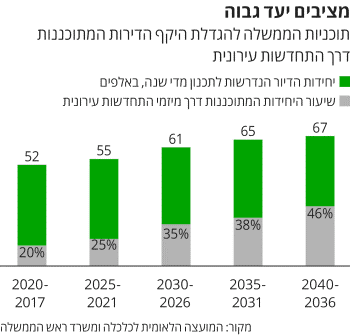
The current state of affairs means that 2020, which was supposed to be the great flowering year of TAMA 38 just before its end in 2022, has become a lost year at best - and devastating at worst.
"2020 could be completely lost for entrepreneurs in the industry, even in the aspect of issuing permits and permits that are currently being delayed due to manpower shortages in the design and engineering systems, and also in the aspect of tenants who could not attend the conferences - and so many processes have been frozen," says Guggenheim. "Emergency regulations set a life-cycle; from collecting signatures on tenant contracts to delivering apartments - which is actually a journey of 7-5 years. Thus, a complete halt has been created in all projects in the industry, which seem to have entered the 'pit' of uncertainty, and are waiting to emerge. "It's as if a piece of time has gone here that you won't return."
Entrepreneurs and contractors are currently trying to pressure decision-makers to extend the validity of TAMA 38, thus creating certainty that is necessary for the advancement of projects that are in the initial stages. Their position joins a three-week approach to the Bar Association - but this has been rejected by the Planning and Construction Ministry.
And what's ahead? Izkowitz believes that the new government can be the basis for change. "The transition of the housing issue to management by new ministers can produce changes. Even if the plan expires, that does not mean that the essence of TAMA 38 will disappear."