



The Marker, Adar Horesh, 18.06.2020
The number of construction starts fell by 2.3% in the 12 months ended March 2020, compared to the same period last year - to just 50,690 apartments. According to data released by the Central Bureau of Statistics (CBS) on Thursday. Also in early 2020.
The period reported by the bureau includes last March, during which traffic restrictions were imposed due to the Corona epidemic, although they did not apply to the construction industry. The figures also indicate a rise in construction starts in March.
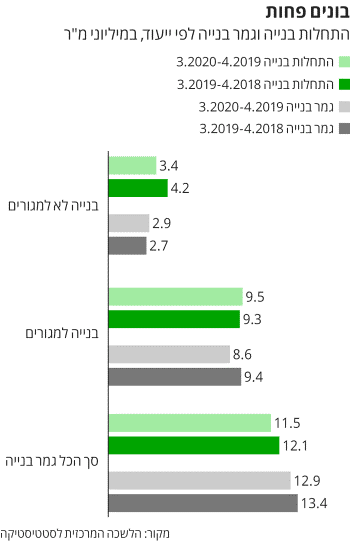
The number of apartments that received building permits increased in the past year to 53,360 apartments. The data mainly reflect the failure of the previous government's housing policy to achieve the main objective of economic policy: increasing construction and housing supply, with a view to moderating price increases. The government's policy, led by former Finance Minister Moshe Kahlon, and its headquarters, was based mainly on a deep subsidy of housing prices for the eligible. The subsidy has lowered housing prices to program eligibility - which is only a small part of the market - but has not prevented continued price increases in the free market.
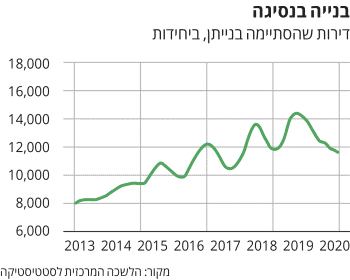
The rise in prices was caused by a shortage of housing supply and the lack of an effective policy to increase the volume of residential construction. Although the number of construction starts rose slightly in 2018, the trend stopped in 2019 and was replaced by the second half of 2019, which continued into early 2020.
Another issue that reflects the problem of government housing policy is that the largest number of construction starts under a cost-per-plan plan were not in demand areas - which are suffering from price increases - but in the southern region. Construction starts as part of the program in the Central Region have dropped.
The country's large investment in the area of urban renewal and theestablishment of a special administration for the benefit of the issue are not yet yielding results in the field. In the past year, construction starts on urban renewal (demolition and construction) totaled only 7,010 apartments, similar to the previous year. The main beneficiary of the initiative was Tel Aviv, where 66% of the projects were built.
The planning ambition to avoid low construction in order to maintain open space is not reflected in the area. The Israel Lands Authority continues to market state land for low construction, and planning authorities continue to plan and provide building permits for neighborhoods and villas. Almost 20% of the new buildings built in the past year were one or two floors, and in the Northern District their weight was 47.4%. One of the reasons for this phenomenon is the failure of the state to motivate entrepreneurs to implement plans for building saturation in Arab and Druze communities.