



The Marker, Yael Drel, Adi Cohen, 09.06.2020
The giant plan to relocate Haifa Bay Negev factories - a national move that has dramatic implications for the housing and employment market - was promoted in March last year by the Israel Lands Authority in the Oron Negev complex, which is considered controversial. The real estate authority promoted the plan while the state was in three election campaigns, leaving it considerable leeway in the absence of ministers to intervene. TheMarker test reveals that the plan is now expected to step up and reach the government table within weeks after the authority has drafted a draft decision on the matter.
At the same time, for the first time, the state also appears to be waking up, and is beginning to monitor the move and to set requirements for its examination. Just a few weeks ago, the Ministry of Environmental Protection put in place a new requirement: the Israel Lands Authority (PMI) must consider other alternatives for the location of the factories - and the Planning Administration has also begun to examine in depth the way it is implemented in the area of the giant plan.
Who will benefit from the property tax and employment mine
The relocation of factories in the Bay of Haifa will not only allow the area to be cleansed of ongoing environmental pollution, but also to market 50 to 100,000 housing units, in an area valued at up to NIS 11 billion. At the same time, the regional councils in the south are already battling for the absorption of the factories, which will be an occupational locomotive and of course enrich their coffers by millions of shekels a year.
But even though it is a national plan, it seems that the person running the campaign is the chief of staff. The plan for relocating the factories will be decided by the planning institutions - meanwhile we are working on the field, and we believe that the draft decision for the future of Haifa Bay and the relocation of activities will be decided by the government, "says Rafi Elmalih, director of the Planning Division at the RPM.
While the draft decision has already been drafted at the PMI, professionals seem to have begun to take a serious interest in it just recently. Absorb the factories complex. The tour was also attended by representatives of the Ministry of Economy, the Chief of Staff and other professionals from the Southern District - alongside representatives of the Society for the Protection of Nature, who oppose the relocation of the plants to the Oron complex for fear of environmental damage in the area.
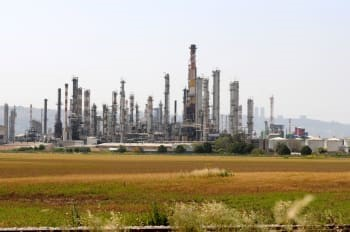 Haifa refineries Photo: Rami Three
The tour focused on the two main alternatives that are currently being considered: the Oron complex, where Rami is currently promoting the program, and another area in Mishor Rotem - which currently supports the Ministry of Economy and Environmental Protection as well as environmental organizations - partly because it is a high-tech industrial complex.
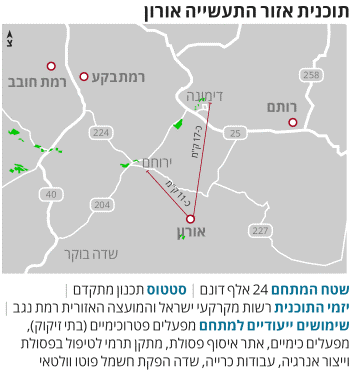
The Oron complex is located near Yeruham and Dimona (11 and 17 km, respectively) in the territories of the regional councils Ramat Negev and the Middle Arava, spans 24,000 dunams, and is mainly used for mining and quarrying. The Great, the Gulchan River and the Mountain Car - but it seems that none of the professionals involved in the out-of-office program can say why the central alternative is actually being promoted in Oron, in an area that is considered environmentally sensitive and will require the establishment of many infrastructures.
RMI's plan includes 10,000 acres to be allocated for heavy industry - of which 3,000 acres for petrochemical plants, 2,000 acres for chemical plants, 600 acres for energy production facilities, and 3,800 acres for other plants. The balance of the land, about 14,000 acres, is earmarked For administrative buildings and logistics and transport infrastructure - rail, cargo terminal and storage areas.
 Tomer Guthelf Photo: Eyal Toeg
The Nature Protection Society explains that "The Oron area, which is located in the heart of the craters' land, is one of the most important promenade areas in Israel and should not be transformed into a huge industrial zone. Haifa Bay to use existing infrastructure. "
Those who are pushing for the absorption of the plants in Oron are the councils of Ramat Negev and Middle Arava. It is estimated that municipal income from Haifa Bay plants reaches NIS 100 million a year, and even if only part of the amount will flow to the Soviet coffers - this is a very significant income for them.
"We are not in a competition of alternatives, but are focused on formulating policy. For us, the question of the factories is less relevant - what is important to us is that the development of the complex in Oron will be a priority for an industrial area," says Ramat Negev councilor Eran Doron. "The industry also has advantages in terms of property taxes - and in terms of employment. Industry is a significant generator of quality employment, which will bring engineers, technicians and other employees to the area.
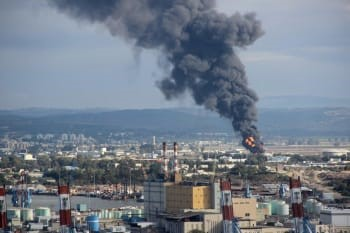 Fire in the refinery complex in 2016 Photo: Ilan Malster / The firm
"As far as property taxes are concerned, this is about 10,000 dunams, of which at least 60,000 square meters are built. In missing estimates, property taxes could reach several millions in the year. This is a considerable amount, certainly not at a time when the region's residents have cut NIS 300 million, with the cancellation of immigrant city status. Only with us in the council, the damage was NIS 36 million. "
The competing complex is the Mishor Rotem industrial area, near Dimona, where the Ministry of Economy is promoting a program. According to a report prepared for the firm by Dana Engineering and the firm of S. Mescuso Architects, this area has about 20,000 acres available for development, which we have shared over the next five years - and will allow for expansion of existing activity in the current industrial area. 28,000 dunams - south of Arad and east of Dimona - is currently the largest industrial zone in Israel.
Shiri Ben-Shahar, chief executive of the Tamar Regional Economic Council, says: "At present, there are 29,000 dunams on the Rotem plateau that can be used for industry, some of which are immediately available and some of them will be available in the next five years. It is important for us to absorb factories in the area as long as they do not contradict the uses of tourism and settlement in the southern space. However, we are cooperating and agreeing with the neighboring councils, and we all see before us the creation of employment places in the eastern Negev, and it is important for us that the government ministries also understand this.
"As for Arnona, there are no doubt that factories that come in are producing Arnona, but we are not dealing with calculations at this time. There are also agreements between the Arad, Dimona and Tamar authorities on the distribution of revenue from the Rotem Plain - so we can definitely say that the area's benefit is in our eyes, not the council's coffers," Ben Shachar details.
Government office, authority and planning administration
In recent weeks, the Ministry of the Environment has sent a letter to Southern District Planner Tomer Guthelf, stating that the PMI should also examine alternative areas at the level of Baqa, Banot Hovav and Mishor Rotem - and even criticized the Authority's conduct on the matter.
About two months ago, ZMT, which serves as the chief of staff's adviser in preparing the report, wrote that the other alternatives in the area were not suitable - among other things: "The Rotem plateau provides a partial response to the needs of the industry and constitutes the state's sand reserves ... Neot Hovav close to Be'er Sheva. .. and the level of hernia should be used for security. "
But the Ministry of Environmental Protection thinks differently, and wrote: "It is evident that in all the industrial areas listed above, there is great potential for establishing a heavy industry of the proposed type."
Planning Administration Response: "The Director-General conducted a tour of the area within which he heard all the relevant factors, including the heads of the regional councils Ramat Negev, Tamar, Middle Arava and Spaces; Representatives of environmental organizations and the Israel Nature and Parks Authority and the Society for the Protection of Nature; Officials from the Ministry of Economy, Defense, Energy and Environmental Protection; We also study the issue and the national needs at stake. "