


The Marker, Adi Cohen, 02.06.2020
Owning an apartment is a dream for many Israelis, and the rate of apartment renters is steadily rising, reaching 34% of the public already - but in the last decade the government has hardly taken any steps in the rental market. Established in 2014 by former Finance Minister Yair Lapid, an apartment rental company purported to build 150,000 long-term rental apartments in a decade. But about six years after its founding, the state-owned company has launched fewer than 10,000 apartments - and in most projects already underway, only 50% of the apartments are for rent.
The long-term rental housing model should give tenants two key elements that do not exist in the private rental market in Israel: certainty and stability - through long-term rent-controlled rental contracts. These are exactly the two main problems for tenants. Tenants' power is minimal with regard to property owners, regulation and oversight by the state or local authorities, and the average duration of leases in Israel is only one year to two years - a definite feature of uncertainty and instability.
"Need a new tool"
The condominium firm's limited resources have also been openly criticized by its former CEO, Uzi Levy, who served in the position from its inception until the end of 2018. "The government has not given us many tools to lead this move. In fact, the only tool she gave us was the ability to market state land without a minimum price. It's quite a bit and that's enough in the demand areas, where we see the entrepreneurs coming, but in the peripheral communities the land has no value - so a new tool is needed, "Levy said at the end of his term.
The government company is currently moving into the hands of the new Minister of Construction and Housing, Yaakov Litzman, and for the first time it appears that the area may receive a significant boost, although unexpectedly: the new minister's desire to invest in rental housing for the ultra-Orthodox sector. The late Rebbe Rabbi Simcha Alter Magur, who was one of his devout disciples, addressed the question of housing for rent in the ultra-Orthodox sector in the 1970s. In a letter he published to his followers, he wrote: For rent to the ultra-Orthodox as a route that may ease the housing shortage in the sector, but as the years passed, the rabbi's vision did not receive government support and the attempts to implement it failed.
The appendices of the coalition agreement that was formed between Likud and Torah Judaism, which promise Litzman control of an apartment rental company, signal the interest he is discovering in the matter. Conversations with sources around the minister indicate that Litzman is indeed planning to give the issue a boost in the upcoming term.
There is a housing shortage in the ultra-Orthodox community and some 200,000 housing units are needed in the next decade and a half to meet expected demand. However, although it is common practice to purchase a pre-marital apartment, many ultra-Orthodox people are forced to rent apartments due to budget constraints.
Yair Tal, managing director of apartment rental, explains that there is an intention to increase the company's activity in the rental housing market. Litzman also understands this, so he took this issue into the hands of the Ministry of Construction and Housing. At present, there is no concrete plan, but both Litzman and Yair Pines, CEO of the designated office, attach great importance to the issue, and talk about increasing the company's volume of operations. "
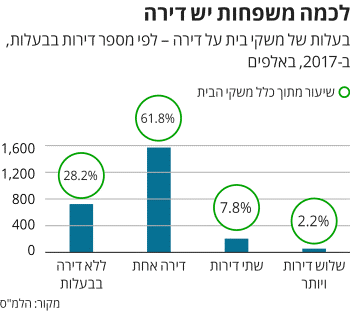
The budget for an apartment rental in 2019 was about NIS 55 million. It includes its long-term rental activities, statutory planning, and the promotion of projects under its designation as the government's execution arm, such as building complexes for student dormitories across the state. This amount is an annual execution budget out of an approved contract amount between NIS 1 billion and the government. The budget does not include about 40 long-term rental projects, which are set up by developers and supervised by a rental apartment, which is worth billions of shekels.
On behalf of Litzman, it was reported that the discussions on this matter were only preliminary, and that there was no longer a concrete plan. However, it was made clear that "the issue of rental housing is on the table, and it has been examined and tested as one of the solutions to the housing shortage - both for the general public and the ultra-Orthodox sector."
"Consider renting a temporary and not a quality solution"
The housing sector for long-term rental in the ultra-Orthodox sector is in its infancy and amounts to individual tenders. The first tender is for a project of the company in the ultra-Orthodox community of Haifa region, in which about 400 housing units are expected to be built, of which about 200 are for long-term rentals. Another rental project is currently underway in the Beit Shemesh Glasses neighborhood, located in the seam between the ultra-Orthodox neighborhood and the national-religious settlement - with a construction of 132 housing units, of which 66 are for rent.
During the past year there was also an attempt to promote a rental project in Bnei Brak, where approximately 230 housing units were planned for construction in the northern part of the city, near the soldier's level. However, due to a dispute over the terms of the lottery for the project, which is close to Tel Aviv, apparently raised concerns from the Bnei Brak municipality about a change in the ultra-Orthodox neighborhood, the project was halted - and the land marketing tender not yet published.
TheMarker test reveals that there is currently a relationship between an apartment for rent and the municipality of Bnei Brak, in an attempt to formulate an outline for the project, which will enable the project to be established while maintaining the neighborhood's ultra-Orthodox character. The municipality of Bnei Brak said in response: "The municipality has indeed sought to preserve the neighborhood character and care for its residents, giving preference to local residents - but does not oppose and never oppose the plan, and even works in full cooperation for its promotion."
Despite the difficulties and fears of groups in the ultra-Orthodox sector of such projects, Tal believes that the benefits of the model outweigh its disadvantages: .
However, the CEO of the government company is aware of the many challenges posed by rental projects to the ultra-Orthodox sector: "In Israel in general and in ultra-Orthodox society, housing is not yet seen as a real alternative to renting an apartment - and perceive it as a temporary and non-quality solution that does not produce long-term certainty and stability.
 Minister Yaacov Litzman Photo: Ohad Zugenberg
"There is also suspicion on the part of the mayors, who fear that housing for housing will bring disadvantaged populations to them. This suspicion is growing when it comes to the ultra-Orthodox sector, which is rejecting government and state intervention in its lifestyle. Part of our challenge is to dismantle this suspicion, to change the branding of housing. For long term rent as public housing, and to embed this product in the market, "explains Tal.
Periphery buyers, living in the center
However, if one looks at the data on the patterns of housing of the ultra-Orthodox sector, it appears that the proportion of renters living among this public is on the rise. This is not very surprising given the rise in housing prices over the past decade and the increasing difficulty of the public at large to purchase an apartment. "Over the years, with the rise in housing, the housing model for the ultra-Orthodox has become increasingly significant," explains Dr. Lee Kahner, senior lecturer in the Department of Geography at Oranim College and a researcher at the Israeli Democracy Institute.
"In the last decade and a half, a mechanism has been created in the ultra-Orthodox community, according to which young couples purchase cheap apartments, usually in remote peripheral communities - such as Netivot, Ofakim and Arad - rent them, and live in a small apartment in Jerusalem or Bnei Brak," says Kahner. According to her, this trend grew in tandem with the strengthening of ultra-Orthodox immigration to the far periphery, which was also led by Reb Gur. Kahner adds: The ultra-Orthodox housing, and it dictated settlement in some of the ultra-Orthodox concentrations in the development towns. "
A government initiative to promote the Rebbe's vision
This trend is also evidenced by the study by Dr. Eitan Regev and Gabriel Gordon from the Israeli Democracy Institute, published last year.
In the peripheral districts, the gap is even greater: the rate of purchase of an investment apartment among the ultra-Orthodox was 59% -73%, compared with 30% -35% among non-ultra-Orthodox Jews. However, the study shows that despite the high rate of purchase of apartments for investment in peripheral communities among the ultra-Orthodox, the proportion of ultra-Orthodox residents living in the peripheral districts has remained virtually unchanged in the last decade.
The research findings support Kahner's remarks that in recent years many ultra-Orthodox have been buying apartments in the periphery, renting them to non-ultra-Orthodox tenants - and renting themselves small, cheap apartments in the center's ultra-Orthodox population. The explanation, according to the researchers, lies in the strong residential preferences of ultra-Orthodox purchasers. The vast majority prefer to live in ultra-Orthodox cities or the like with a distinctly ultra-Orthodox - and moving to peripheral field cities is a bad default for them, preferring to avoid it.
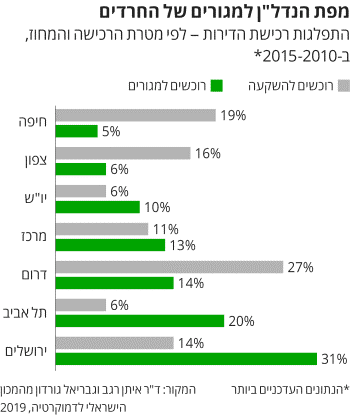
"In general, it can be said that most young ultra-Orthodox couples, at the outset, will make great efforts to determine their residence in Jerusalem, Bnei Brak, Beitar Illit or Modi'in Illit. However, in view of the resource limit and high price levels in these cities - many will choose to 'stick to the stake' In the market and buy an apartment for investment in the periphery, ”say Regev and Gordon.
According to the researchers, living conditions in many of the rented apartments are at the center of those particularly harsh investors - and they serve as a temporary solution until they move into the apartment they purchased for investment. This means, as Regev and Gordon anticipate, that within a few years, entire neighborhoods in the periphery with high investment concentrations of the ultra-Orthodox public - "will almost overnight become ultra-Orthodox neighborhoods."
Regarding the renewed push the government is receiving today, Kahner sympathetically says: "To date, when discussing housing solutions for the ultra-Orthodox public, we have mainly discussed how many apartments need and where to place them. The government's focus today on the housing sector for the ultra-Orthodox public has a new and significant statement: Experience To revive the idea that led to the time of the Rebbe, the ultra-Orthodox population and in general - only with greater and broader intensity, as it comes from a government ministry. "
"More and more ultra-Orthodox are moving in for rent"
For his part, Litzman, who is the official representative of Gur Hasidim in the Knesset in Agudat Yisrael and the trustee of the Reb Gur, was previously a member of the Gur Hasidim housing committee, which at the time promoted the establishment of Hasidic temples in Beit Shemesh, Ashdod and Arad - and also worked to promote subsidized housing projects, Aimed primarily at the ultra-Orthodox public.
Later, in the 1990s, Litzman was sent on behalf of the Central faction in Agudat Israel to serve as the assistant to who was Deputy Minister of Housing, Meir Perush of Torah Judaism - to promote the Rebbe's rental housing vision. The importance of the subject for Torah Judaism, and the intention to promote it primarily for The ultra-Orthodox public was visible.
"The Torah Council decided to join the coalition only on the explicit condition of holding a housing project for the ultra-Orthodox public," wrote Perush in 1997 to then Finance Minister Yaakov Ne'eman, as part of discussions on the state budget. During those years, Perush and Litzman promoted the construction of 600 apartments for rent throughout the state, subsidized by the Ministry of Housing, of which 510 were allocated to horticulturists.
There is no argument about the distress, but the ultra-Orthodox entrepreneurs disagree with public preparedness. Yaki Reissner, a veteran ultra-Orthodox entrepreneur, says: "The difficulty of generating housing demand for the ultra-Orthodox public does not stem from the fear that they will be evacuated or unstable in this type of residence - but from a very old perception of apartment ownership.
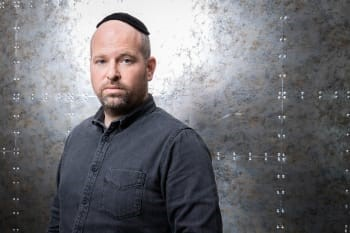 Yaki Reisner Photo: Eyal Toag
"The fact that the ultra-Orthodox population has a higher rate of apartment owners than the general public reflects the ultra-Orthodox way of life - by which you invest all the money in the apartment. Those who cannot afford to buy an apartment - will rent, but the apartment for rent should be very cheap and attractive, so "The potential exists - but probably will not be realized in cities like Jerusalem or Bnei Brak, but in remote peripheral cities, where prices will be much lower."
Shuki Salomon, CEO and owner of Salomon Properties and Real Estate Brokerage Real Estate, says otherwise: "In recent years, the ultra-Orthodox public understands that this condo is not necessarily available - and is seeing more and more people moving to rent, and Openness to this idea. "
Regarding the location of apartments that are being purchased by ultra-Orthodox buyers - for investment or residential purposes - Salomon says: "The ultra-Orthodox investor does not pay to buy an apartment in Bnei Brak, where prices are sky high and will eventually receive a maximum yield of 1.5% -2%. The ultra-Orthodox public invests in the periphery, where Prices are lower and the return on money is higher. "
"Don't give entrepreneurs a real reason to come"
Haredi real estate developer Yehuda Herzig believes that the demand for housing for the ultra-Orthodox community is high and low, but the few attempts to advance the area are difficult to create for entrepreneurs, and often in the cut off of planning for the ultra-Orthodox public. " The needs of the ultra-Orthodox sector, the planning implications of community life and lifestyle, and the diversity that exists within it. Demand for multi-sector housing, and as prices rise, the shortage increases and fewer people can afford to buy an apartment - the demand for rental housing is also rising. I am sure that when a supervised rental project is implemented for the ultra-Orthodox sector it will be hijacked within 24 hours, "he adds.
He said, "The problem is that the auctions that have come out so far do not give entrepreneurs a real reason to come. There is difficulty in bringing entrepreneurs into rental projects, and a tenant is having difficulty finding the developers who will compete for such projects. To the general public and also to the ultra-Orthodox sector. "