



The Marker, Gili Melnicki, 27.05.2020
"It looks like the outbound and outbound traffic at the airport has moved from Ben Gurion Airport to my work complex," a man hiring an office for six employees in a collaborative work space in central Tel Aviv said this week. All day, potential renters are hanging out here, and salespeople work like they never worked. "
It seems that while the traditional office industry is dealing with entire office floors that have been emptied and with the retreat of investors , the relatively flexibility in rental prices and exit points from contracts in the shared work space allows for a smoother return to activity, and even increased traffic and increased demand. While the major players in the high-yielding real estate market, including Ampa, Azrieli and Mamot, did not give discounts to tenants associated with them over years and thousands of sq.m. , Responded quickly and began to make some assumptions.
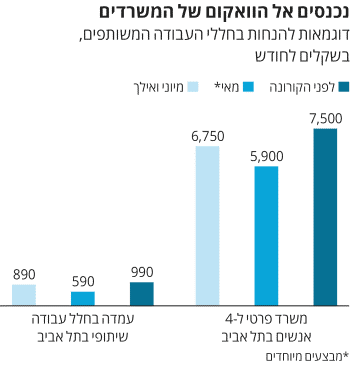
Along with the renters 'discounts, the smaller work complexes were quick to come out with new hires' introductions and offer a substantial discount on rent in June (starting at 50% off until the first free month). TheMarker test shows that Brain Embassy from the Edgar Group, for example, is offering a 50% discount on June-July; The Technart complex on Carlebach Street in Tel Aviv offers a free first month; wework allows long-term renters in some of the complexes up to 50% off on the first month; And Urban Place, which operates spaces in Tel Aviv and Jerusalem, promised existing customers an exemption from rent for a month and a half of the Corona period, assuming it expires a year ahead. The price of a stand in the prestigious complexes - about NIS 900 on a regular basis - can now offset to NIS 650-700, and the rate for a private office for five employees (about NIS 9,500 a month) may fall to about NIS 7,500. However, most of the sites in the industry currently offer discounts for an average of 10% -20% of the pre-crisis closing price, including wework,Who is battling an image crisis for the unsuccessful issue and the affairs of Adam Neumann.
The current assumptions are likely to be a response to a long period of deal paralysis and a decline of tens of percent in April's occupancy. Only recently did Wiwork Israel CEO Benji Singer in an interview with TheMarker that during the crisis, occupancy in the company's complexes dropped to only 5%.
"It seems that all companies in the field are now trying to refill the spaces, and the rate of return to the routine is faster than expected," explains Asaf Tidhar, CEO of Spacing, a site for comparing prices between work complexes in Israel. " Because May is in demand for their pre-crisis levels. "Tidhar estimates that besides existing customers who have resumed their operations, a new wave of applicants for the industry - medium-sized and large companies planning to enter their own offices, but due to concerns about a further corona wave and uncertainty over continued leases - "Those who intended to sign a standard office contract and invest an additional NIS 3,000-8,000 per square meter in finishing, designing and furnishing work would rather wait rather than rush into a long-term commitment, and in the resulting vacuum, the work spaces will become more viable."
"Most discounts will be erased by June"
Spacing claims that the discount in rent prices aside from improving positions after "breach of contracts" has also prompted demand from high-tech companies that were not badly affected by the crisis, but prefer to stay liquid and not enter assets during this period. For the self-employed, the response to the crisis is wide-ranging: those who have been hit hard will prefer to adopt the work model from home as much as possible, and those who find that work from home severely impair their productivity are quick to find a cheap work position.
Roman Levy, co-founder and CEO of the Shared Work Space Complex Urban Place, which operates two complexes in Tel Aviv and one in Jerusalem, indicates that, on average, 90% occupancy in January fell by 50% in March-April. However, Levy claims that in the first three weeks May saw a 20% increase in occupancy rates, and referrals were higher than before the crisis.
"We had to cut the price list by about 10%, and adjusted ourselves to competition with different types of benefits. We learned from our customers that the only way to recover is to work together. About a month and a half of paying for empty offices. "
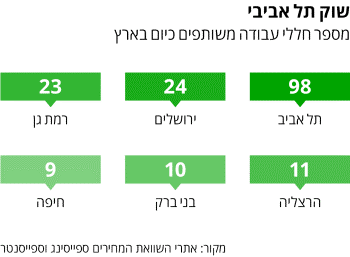
Uzi Sorkis, CEO of the jointly owned Be All complex, owned by Ness Shoval real estate man, operates five complexes in Tel Aviv. "The crisis hit everyone, and you can't ignore it, and the response is also about a 10% discount. In April, there were hardly any new inquiries, and existing customers demanded payments and discounts. We thought it was a temporary situation and we were trying to get out of favor with customers. You have to behave in a community-like manner, so the collaborative space industry responded more quickly than the traditional office industry. ”In the window of opportunity that opened, each network offered deals, and we have witnessed inquiries in recent weeks that we did not know. Most of the assumptions will be eroded and in June we will return to routine prices. The market for activity. "
Game Name - Flexibility
Nir Kellner, director of global operations for Edgar's joint work complexes, whose occupancy rose by 15% in the first two weeks of May, agrees that price benefits will not remain forever, but adds that my perception of change will seep. "We offer in-house consulting packages, secluded office units for companies that want their own space, and mostly allow flexibility as a lifeline for uncertainty companies. Flexibility turns out to be the name of the game, and that requires the traditional market to change."
The current benefits in the industry reflect not only price reductions, but also a change in the nature of the contract: contracts with more flexible and more points of departure, new models of payment by several positions or short periods of a week and two weeks, gradual return without immediate commitment, subsidizing services through collaborations between The companies that operate in the complex and more.
"For companies that are uncertain about the number of employees, we are a great solution," says Ziv Ford, vice president of operations and sales at Rooms (Fattal Network's work spaces). "New companies come because of flexibility and price, and close because of product, service And the design. "
"The collaborative work complexes have suffered from image damage as a result of the wework crisis, but the Corona crisis has proven to be a profitable economic model that is not a transient trend," says Levy. "The attractiveness of the sparkling office towers is eroding. Medium and large companies, which were the steady target audience of office towers, are threatening to abandon, as the crisis has challenged all existing conventions and has also changed the employment model for work from home.
"Companies that will not be able to adapt to the changing world will find themselves with empty office space and become irrelevant. If the Israeli office market wants to continue to make a profit in the post-Corona era, it must adopt models with flexible principles."