



The Marker, Adar Horesh, 25.05.2020
Preliminary data suggests that the Corona crisis has almost completely overlooked the housing sector. While contractors' sales offices remained closed for three weeks, and second-hand apartment sellers had to wait for the deal to close - however, according to many evidence, the market is far from lacrosse, and many of the deals close at similar or identical prices for deals in the days leading up to the crisis.
Part of the reason for the impressive housing sales statistics is a cost-per-enterprise venture: lottery winners continue to sign deals to buy the discounted apartments, and in fact, they are realizing deals that closed before the big closure.
Jacob Nitzan, chief executive of finance company Robbie Capital, says housing prices for projects financed by the company have even risen slightly in the days of Corona, and despite fears of contractors' collapse and buyer disappearance, he expects a sharp increase in demand. But the stability of the housing market does not, of course, affect real estate. Others, where risk levels have skyrocketed.
 Jacob Nitzan, CEO and partner at Ruby Capital, Photo: Effi Attias
Nitzan says in an interview with TheMarker: "We have seen a slowdown to almost a complete halt in sales during the closure. Over the past week and a half people have been making purchases, albeit at a slow pace over the pre-crisis period, but the market is starting to move backward. There were price declines - there was even a slight upward trend.
"It turns out that the initial psychological impact of the closure was relatively quick: if there were reductions, the prices at which the apartments were sold would not be below the price set in the 'zero report' where the project's business plan is presented."
"We did not experience a collapse due to a real estate developer"
Ruby Capital is a small financing company that specializes in credit for small and medium-sized contractors for relatively short periods of two to three years. The clients are entrepreneurs who want to complete credit for the construction of projects - relatively small-scale credit, projects for several dozen apartments, TAMA 1 ventures and the like.
The company was founded in 2015 by three investors - Ilan Rubinstein Gershon Shapira and Andrew Mastel - who originated their capital from real estate families in Canada and the US. The company did not raise capital from local investors, except credit institutions from institutional and banking bodies, including the best lapel . Nitzan, CEO and partner in the fund, took office on the eve of the Corona crisis, having held senior real estate credit positions with Harel and Mizrahi Tefahot Bank .
The company says that so far there has not been a financial collapse of a real estate entrepreneur who did not meet the debt repayment. It is in the residential area, and the balance is in credit for the erection of commercial and office buildings.
There were allegations that the banks were taking advantage of the crisis to raise interest rates for tenants and contractors.
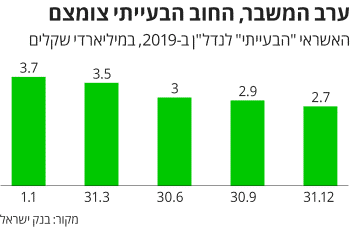
"The fact is that interest rates rose by 0.5 percent to 1 percent, but I don't know why. This may have been an opportunity here as well: Entrepreneurs came under pressure and had to raise credit for some reason, and when a banker offered them high-interest financing at slightly lower market prices, they They were quick to take only to enjoy the sense of security that they had secured funding. There was no other reason for the interest rate increase.
Bankers said this was a natural reaction to the rise in risk in the market.
"I haven't felt a change in risk metrics, at least in the housing market. It's a very strong market that continues to operate at a high level of leverage. In the past, an entrepreneur would have required 30% equity to start a new project. To a leverage level of 90%, and I don't see a demand in the market to reduce that leverage level. "
But still something happened in the market. Everyone knows that projects have been delayed and apartment deliveries will be delayed at least a month.
"The fact is that the interest rate that rose during the closure period has not returned to its previous level, although sales have risen and the pace of construction is rising again. Even if there is a one-month delay and elongation during the repayment, this is not a delay that was not predicted in the contractors' zero reports."
What should be done to prevent prices in the housing market?
"The state needs to reduce the amount of land allocated to a CPA and increase the supply of land for free-selling construction. The CPA is only suitable for large construction companies, leaving small and medium-sized contractors outside. These contractors need to enter the market and increase competition and scope of construction.
"The CPA plan should not be canceled, also because we still have to put in houses and protect them from earthquakes. This plan allows thousands of housing units to be added, and needs to be adapted to urban plans. The state needs to find a way to support the local authorities, which require, Rightly so, the expansion of infrastructure. One of the important solutions should be the expansion of long-term rental projects and the exit of land tenders for the establishment of such projects.
Why don't you rent?
"We have not yet made a final decision to enter into long-term housing projects, but we are negotiating to enter into a partnership for a long-term apartment rental project. It will be the first investment of its kind for Ruby Capital because we have so far specialized in relatively short-term loans. "
Where do you see risk anyway?
"As a matter of principle, we have discontinued credit for construction, trade, office and hotel construction. The office market is currently a very dangerous market. "We see entire floors of offices that did not return to full-time work, and even now half of the offices remain vacant . In two or three years the market may return, as it was in previous crises."
Entrepreneurs invest in hotels, after all
You mentioned in your words the hotel industry. Are there any entrepreneurs today who want to build hotels?
"Some entrepreneurs get stuck in the middle of construction or need more funding. Mostly, they won't tell you they need the money for a hotel project, but they'll tell you they need the credit to free up capital for another project, but when you look into it, ".
Some say crisis is an opportunity. Maybe it's the right time to invest in offices after all?
"Can be. The discount rates for property valuations in the office sector are expected to rise by about 0.25%, which means that there will be a significant decline in property values and real estate prices, especially after we see a large shortage of commercial building plots in demand areas. Prices may be higher in four to five years, but those who try to seize the opportunity will take a big risk, and we're not there right now. "