



Calcalist, Dov Cohen, 22.05.2020
Now that the Corona crisis can be talked about in the past, one of the most interesting questions that arises in the real estate context concerns the most expensive and sought after area in the local market: the city of Tel Aviv, and especially the neighborhoods in the center.
After the last few weeks, data have been released about up to 10% drop in rental prices in the city, some investors have come under pressure. However, an examination of market habits and past crises shows that Tel Aviv's apartment owners really have nothing to fear.
According to CBS data released last week, in February-March, house prices rose by an average of 0.6%, similar to the rate of increase in prices in the two months before; Tel Aviv led the trend with an average increase of 0.7%.
Indeed, there are those who believe that even a global crisis will not lower prices in demand areas. Prof. Danny Ben-Shahar, chairman of the Elrov Institute for Real Estate Research at Tel Aviv University, said in early April, at the height of the Corona crisis in Israel, that "a decline in transactions always comes with a decline in prices, which is probably what we see at least in the short term." , I do not believe that in areas where demand is high, prices are falling.
 Dudi McCase
"In the Tel Aviv area, for example, demand surpluses are very large, and so the price crisis will also not decrease. Prices will fall in the peripheral communities. Subsequently, demand will rise because there is a steady increase in the population and people need a place to live."
Immigrants to Tel Aviv
Like the appraisers and the research people, even among the developers working in the field, the mood is mainly positive, especially for those who work in Tel Aviv's "hot" neighborhoods near the sea, which enjoy the demand of deep pockets, including foreign residents. "In the very short term, there are three possible scenarios," Dudu Makase, co-owner of the city building company, analyzes the reality that is true for the Tel Aviv real estate market: "One is a fall in prices, which even if a ceiling lasts a few months at most, and in any case is not significant but Of individual percentages. This is because it is only a matter of time before investors, both Israelis and Jews from the world, return to purchase apartments in the area.
"The second scenario is stagnant, but the likelihood is not high either - even as the former finance minister tried to lower prices by excluding investors from the real estate market, while the volume of transactions and demand is small, but prices in the heart of Tel Aviv remained more or less stable, with a tendency to rise slightly; There are still quite a few who are patiently waiting for a lot of liquid money to drop prices in Tel Aviv, to buy an apartment for a child or for vacation.
"The third scenario, which I think is most likely, is a rise in prices, partly because since the beginning of the crisis there has been a decline in investors from the fence. There is also great interest from overseas investors, who have seen how Israel has performed well in the Corona crisis and wants to strike a stake here. Opposite them these days too, through zoom calls and interactive apartment tours. "
McCase's remarks are also strengthened, among other things, by the Jewish Agency's estimates that in the next two years, in the shadow of the global epidemic and the intensification of anti-Semitic events in the world, some 100,000 immigrants will land in the country. Many of them, as the local real estate market already knows, have the means to look for a prime location.
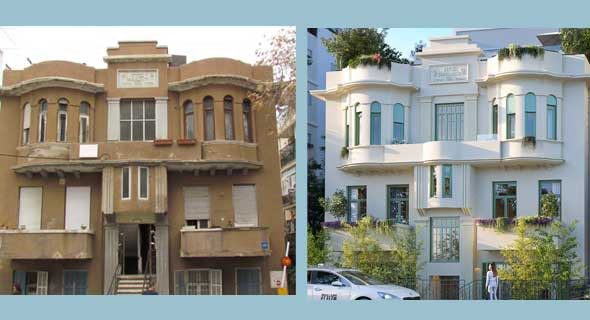 The building at 19 Pinsker Street - old facing new
Luxury for the people
The city building is a different company in the landscape of Tel Aviv real estate entrepreneurs. Unlike companies that carry out classic urban renewal projects, the city building acquires and rebuilds small buildings of up to 20 apartments, including historic buildings with stringent conservation restrictions. Old and in addition to their coveted location, they suddenly become a boutique pearl that attracts middle-class investors - from the country as well as overseas.
One of the company's talked about projects, whose construction is already under way and with the exception of the penthouse, has already been marketed entirely, is the one on Rambam Street 3 in the city. The project, located between the Carmel Market and Nahalat Binyamin Street, within walking distance of the sea, is operated entirely as a short-term rental building, maintained and managed by CTLV GLOBAL and has become a role model for investors seeking creative solutions to diversify their investment model.
Another notable venture of the city's building is at Pinsker Street 19. According to Rai Cohen, CEO and owner of the STADIUM ISRAEL marketing company that markets apartments and manages investment properties in Tel Aviv's demand areas, "this venture is a great example of a unique and historic asset that will be preserved for generations. . It is intended for customers who intend to live in a luxury apartment with parking and all facilities - pool, parking, proximity to the sea, etc. "
"I was exposed to the building at the beginning of the decade, and it immediately caught my eye. So I brokered it to an entrepreneur who sold it to me after I became an entrepreneur myself," Macays recalls. "For years I made sure to follow his story, and found that the potential in this building was enormous. Entrepreneurs did not really know how to deal with the complexity of the building and were reluctant to meet the city's stringent conservation requirements. For a wonderful creation in this crazy city. "
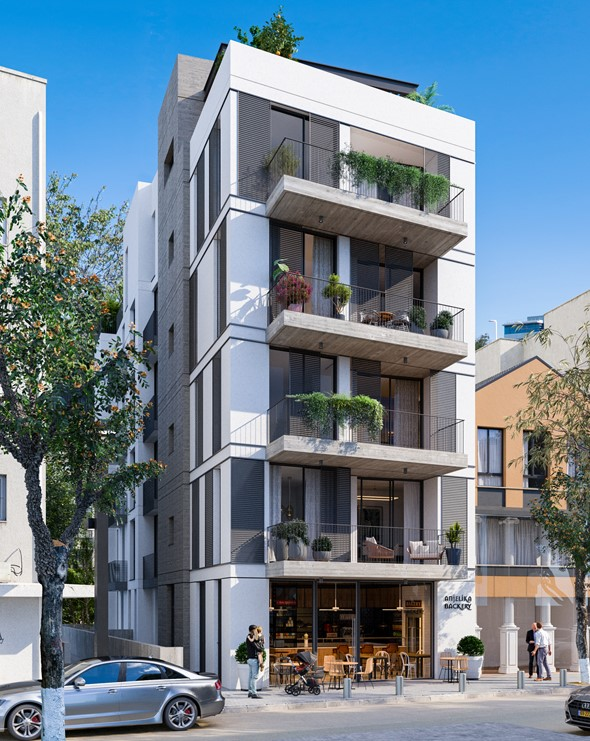 The building at 16 Montefiore Street
The rebuilt building at 16 Montefiore Street is also an architectural gem, but unlike Pinsker is of a modern nature. It basically includes classic, 2 and 3-room investment apartments, and ground-floor cafes on the street level.
"We feel that recently, not only investors are interested in buying apartments in central Tel Aviv," Cohen adds. "What used to be the Upper Alpine estate or foreign residents who buy apartments to put their money in Israel has become a big concern among pensioners who want to reduce housing, live in the best places in the country and indulge in their quiet years in life."