



Globes, Eric Mirowski, 29.04.2020
Moshe Kahlon's term as finance minister has already ended a year or more ago, and today the situation in the housing market is one of the worst that his successors in housing management in Israel could wish for. Not only because of his policy, which was criticized many times in different directions, but also because of the Corona epidemic, which soon made the policy irrelevant to these days.
Kahlon's legacy has almost nothing to suit these days, and in the Emergency Government's tenure, budget-friendly housing policies are likely to be formulated and modest in its long-term goals.
What lessons can be learned from the last term? Where should things be fixed? At almost every point.
1. The Toolbox concept fails
Kahlon came into office with the view that if he was given all the government agencies that control the housing sector, he could push the industry forward. He was asked for what he wanted, and he received the RMI, the Planning Administration, and the National Planning and Building Council.
Kahlon used his powerful position as finance minister to also transfer billions of budgets to the industry, and to promote legislative initiatives that were usually promoted by the Justice and Home Affairs ministries. His executive arm, housing headquarters, has tried to implement the policy.
On paper, this seemed a promising model because Kahlon's and his people's main claim was correct: There was a difficult problem of synchronization between the various housing bodies, each of which belonged to a different office.
Ahead of the current government train, the Interior Ministry, led by Minister Aryeh Deri, made it clear
That he would like to return the Planning Administration to him, but Tal Schneider, the political correspondent of "Globes", has stated that apparently Ya'akov Litzman, who is supposed to receive the housing portfolio, also requires the Israel Lands Authority and the Planning Administration, that is, he wants to take the same "Toolbox".
Not only because of the treatment of the Corona epidemic, Litzman preferred to move to the housing ministry: the problems of the ultra-Orthodox ultra-Orthodox public in the housing sector are real and difficult. Affordable housing prices are seriously hurting young people, who have to live in harsh and makeshift living conditions.
"The ultra-Orthodox sector has a huge number of apartments for young couples who get married year after year, and most of them have no penny in their pocket. The distress is extremely difficult: some will say that in the next decade, 200,000 apartments will be built! Only for the ultra-Orthodox sector. The number is not imaginary, "Litzman wrote to Prime Minister Benjamin Netanyahu in May last year.
But even if Litzman really gets into the hands of the PMI and the Planning Administration, he will find that the realities in the construction and residential sector are complicated.
Even when the entire toolbox was in the hands of the finance minister, it became clear that most of the problems were not about inter-office synchronization, but about the multiplicity of domains and the plurality of players in the real estate and housing sectors, which no toolbox can really control - and certainly not in a democratic state.
And in the test of results: house prices did not fall, and what dropped was construction starts, which peaked at 56,000 in 2016 and have been downward ever since.
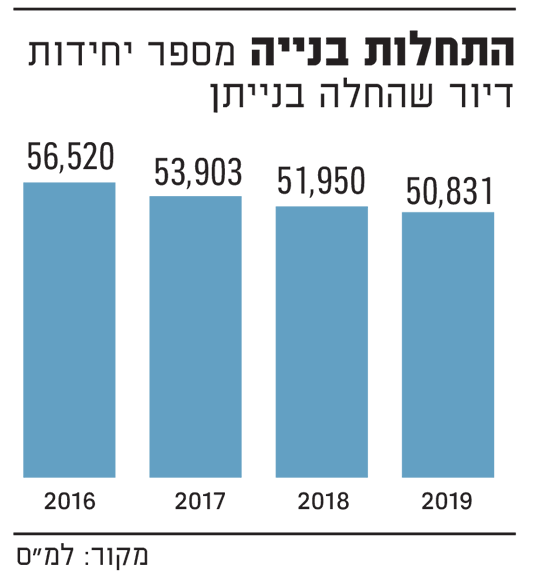
Construction starts
Housing prices also did not fall: they completed a 16.4% increase in Kahlon's tenure. True, it's not the gallop we've seen before, but it's quite a bit.
Thus, you can see that only a fraction of the depth problems of the industry have been solved, and this could also be achieved by better means than a toolbox.
2. Dr. Planning and Master and MSc
The Planning Administration has done some good things in recent years: Only last week, the Administration issued a detailed document proposing to abolish construction plans relief - one of the ills of the planning and construction industry in Israel. The Administration also completed the National Outline Plan (TAMA 1), which unites most of Israel's infrastructure and nature conservation programs, and is a real achievement; accelerating the pace of planning in the district committees can be said for many things - not all of them positive.
However, the administration had two faces in the last term: Dr. Jekyll, the Planning Directorate headed by Dalit Silver, and Mr. Hyde, the Deputy Chief of Staff - an alternative planning arm whose function was to fill quotas imposed by the toolbox heads.
Thus, one hand promoted the principles of urbanity, efficiency and sustainable transport, and encountered remote neighborhoods, detached plans and outdated access of large, wasteful and unmanageable localities designed by the second hand, the VPM.
In any case, much of the approved housing units will not be built in the coming years. Most of the attention was given to the medium and long term, and many times spoke of beautiful, but purposeless principles.
In the new government, the Planning Administration will need to clearly address things and focus on the short term. The burning issues at stake: available licensing, slowness and politicization in local planning and construction committees; TAMA 38 that was canceled before it was presented with a proper replacement, the rooftop agreements amounting to tens of billions of shekels are clearly not implemented for the most part, but perpetuated the construction of tens of thousands of apartments in unsolicited places, in suburban neighborhoods.
3. Price per user has exhausted itself
Much criticism has been gained in this program over its five years of existence, and most of it is also recognized and mentioned in the last state comptroller's report and in a document issued by the Attorney General. The inequality between the center and the periphery, the uncertainty surrounding data from apartment grills, the quality of apartments, the temptation the program has given young couples to purchase apartments in the periphery for investment and more; Everything is familiar.
The latest audit was written about a month ago in the Bank of Israel Report for 2019 According to the report, between 2015 and 2019 land containing 48% of the apartments planned in the periphery and 32% of those planned in the center of the country remained unclaimed. That is, the periphery is largely "burnt out" and also what is offered in the center of the country does not always win the market.
Currently, more than 1,400 flats are being offered for sale to a lottery-free resident, most of them in the periphery. This, after trying unsuccessfully to sell them for more than a year, moved to a position where they can also be purchased by housing enhancers. The market emitted them back.
In a situation where the periphery was flooded, and even in some places in the center of the country, local flooding was recorded - there is not much stock left in the country to meet the requirements. The housing units offered under the various lotteries have been declining since the end of 2017, and the plan, it seems, is slowly fading.
In this case too, the corona devoured everything. These days when people find the USSR and are fired and the state is struggling to formulate aid policies - the last thing anyone needs is encouraging young couples to embark on an apartment buying adventure.
The question facing the Minister of Construction and Housing will be whether to interrupt the plan at once and announce its termination, thereby violating the government's promise that anyone who is registered can win the apartment, or let it slowly die.
Either way, officials will have to leave the grills and projects for several years to come. In practical terms - so far just over 5,000 apartments have been occupied.
What can you offer instead? In a crisis situation, the purchase of apartments is expected to slow down significantly, and the market that will rise will be the rental market. Assistance to renters will be cheaper and more appropriate these days.
Among other things, investors must return to the market - this will also help to regulate rental prices and also bring money to the state through taxation.
Kahlon's policy resulted in hundreds of millions of shekels going out of the country each year for overseas real estate investments. One can wonder about the degree of logic in such a step even in the days to be corrected, but in an emergency it seems really irresponsible.
The only way to attract investors is through the purchase tax reduction. Reducing taxation as a whole will spur market activity and put money into state coffers. In the current term, the conditions for this may be more favorable.
4. Housing headquarters: The thing worth preserving
If there is something legacy like a window that is absolutely essential to preserve - it's the housing headquarters. In fact, if there is one thing where the housing and construction industries can provoke the envy of the other economic sectors in the economy - it is this body.
The housing headquarters is a body that does not include many officials, but is highly skilled, knows all the factors and actors - from home buyers, through developers, through heads of communities, and to the tangle of government agencies dealing with housing.
The current emergency really requires the existence of this body, which can channel government policy, remove barriers on the way to its realization, and at the same time listen to the feed back from the territory.
These are the most important features that a government executive arm can have, on the way to designing a good policy to deal with the Corona crisis, which will clearly benefit us, but its strength is still unclear.