



The Marker, Gili Melnicki, 24.03.2020
The chapter in the state comptroller's report on a cost-per-plan plan repacks everything that has already been said about the flagship housing plan: it managed to stem the rise in housing prices for a very brief moment - but at a heavy price of only NIS 6 billion in its first three years. The housing ran it, even though the needs of the eligible were not examined, both in terms of areas of demand and types of dwellings, and without knowing what their goals were or what their economic cost would be.
Bottom line, the report doubts the program's ability to address the housing crisis that caused young people to enter the streets in 2011; of the 20,000 housing units examined in the report, about 6,000 had not yet received building permits at the time of writing; It is also expected that there will be a delay of 8,600 additional apartments.
The auditor's report is published against the backdrop of a global corona crisis and the climax of a political plunder around a government that has not been functioning for a year and a half. This means that the tap that watered the program will probably not close, and until a stable government emerges - there will be no body responsible for stopping the program and redeploying But what is not written in the auditor's report, which should be put on the table, is that the state does not have the extra billions of shekels to finance a program that does not achieve its goals. The commitment to help the young and homeless couples in Israel is a task that the next government will also need, but it is doubtful whether the price tag could average NIS 2 billion, given the current economic situation.
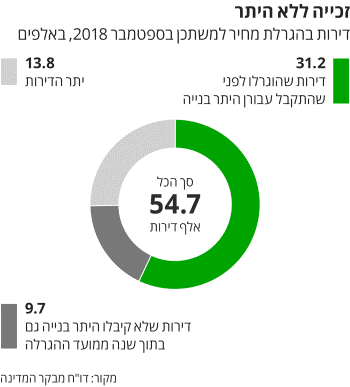
The focus of the report is the manner in which the plan was managed, and it highlights two important points. The first states that the price per dwelling - which was intended for the young couples - did not take into account their needs. According to the report, "it was possible to ascertain at the listing stage what the preferred living area, The preferred apartment size and the maximum amount that registrants are willing to pay, and formulate a database as a tool for making more informed decisions. "
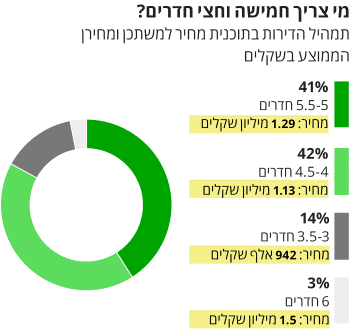
The report shows that the size of the apartments in the first three years of the program was not tailored to the economic ability and needs of young homeless people (which was frequently published in TheMarker). For example, 41% of apartments received for building permits by May 2018 were 5 apartments. Rooms and above, and only 14% of the apartments marketed were 3–3.5 room apartments. In addition, the average size of the apartment - a balcony or a courtyard - was 35 square meters, which greatly reduced the prices of the apartments, leaving hundreds of garden apartments and penthouses without buyers.
Insist on the periphery - and create new problems
Another concept that the report points to is the housing marketing areas, which were not adapted to the needs of the eligible. For example, 58% of lottery winners were from Central and Tel Aviv District, but in the period examined, only 30% of the apartments marketed were in this district.
The critic also mentions that the strategic plan for housing, prepared by partners of the Ministry of Construction and Housing, the Chief of Staff and the Planning Administration, states that "the ability of the government to back up the population's peripheral dispersion goals with regard to generating questionable employment, and involves huge financial investment "Health and education." That is, RMI knew that the many peripheral markets only created employment and access problems.
In addition, the report mentions an analysis conducted by the Knesset Research and Information Center, which shows that the price of the apartment in the plan is an average of 21% lower than the market price, but the level of discounts between the various marketing areas is unbalanced: the average price per apartment for a Southern dweller was 175,000 NIS from the market price in the north of the country - NIS 195,000 from the market price, while in the center of the country, an average price of NIS 600,000 has been granted to the dweller on average, which has not been corrected so far, except for a few cases.
These figures were known to decision-makers already in real-time: The housing cabinet hearing held in July 2015 stated that the assumptions about the apartments in the plan are unbalanced, and this should be corrected by combining the assumption of land with the subsidy of the land development and providing grants to the periphery.However, the auditor avoided dealing with the difficult questions that this raises, dismissing himself in a brief summary, which states: "This did not succeed, and the lottery winners in the center received a higher discount than the assumption received by the winners of the periphery."
This gap was also discussed by the Knesset Economics Committee in February 2017, but did not interfere with the housing cabinet to reauthorize the plan in January 2018. The solution already approved in May 2017 as a tool to reduce the gap in discounts was not implemented properly, the critic writes.
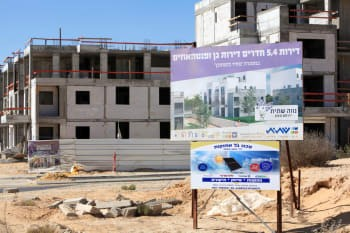
Project for a price for a resident of YeruhamPhoto: Eliahu Rashkovitz
Also, the attempt to allocate a small proportion of the apartments in favor of eligible public housing, which is thirsty for apartments in the center, was also not properly implemented. The decision was expressed in a few tenders in Jerusalem, Beer Yaakov and Even Yehuda, and not in other demand areas such as Rishon Lezion, Netanya and Kiryat Ono, where the discount on the apartment is large compared to the other localities.
Management is almost irrational
The auditor also refers to failures in meeting the plan's schedules, which put the beneficiaries on high interest costs and prolonged linkage to the construction input index. Thus, although the lottery policy for eligible persons stipulates that a lottery registration will be opened only after the developer has received a building permit, the report states that "in practice, most housing units were raffled among the eligible before they were granted permits."
In addition to the many failures, the report reveals almost irrelevant management on the part of the Chief of Staff, which led the National Planning and Building Council to make voting decisions without a minimal database and without monitoring and controlling mechanisms for its operations. .
For example, in the April 2016 decision to provide incentives for local authorities in which apartments will be marketed, and a November 2016 decision, according to which the PMI can give 80% of the land value also on apartments that are marketed in the free market in places where land values are low - the economic data was not included. In fact, the PMI received two tubes for distributing benefits to local authorities and entrepreneurs, without any clear criteria or considerations that are open to the public.
Even when government decision-making proposals were examined when approving a cost plan for the June and July 2015 residents, and in deciding to extend the plan in January 2018, RPM did not appear to present the full economic implications for the plan. "Although information on the loss of state revenue for land discounts has been provided," he writes. The auditor in the report, "but no information was provided on the expected reduction in collection of taxes, such as value-added tax and apartment purchase tax, for providing discounts on the land and its impact on the cost of implementing the plan."
In its reply to the State Comptroller's Office of January 2019, the Chief of Staff wrote that "it is working to include a review of the budgetary and economic effects of proposals, as well as professional opinions, including legal opinions." The auditor remarks to the Chief of Staff and the Ministry of Housing that this is a process of producing a lack of lessons. Non-price aspects were not examined alone, including aspects related to the project's planning status or supply and demand in the marketing area, including the stock of apartments built on Israeli land and privately owned land.
For example, between November 2017 and May 2018, the PMI published three successive tenders that failed on a plot to build 208 apartments. The price of the plot fell from NIS 162 million to NIS 108 million, and the report states that "in the decision of REMI on marketing Plot reversals did not include an examination of the economic implications of land price reductions and benefits payable amounts, and no alternatives were considered. "
The Israel Lands Authority said in response: "The cost to the resident has almost doubled the RPM's income, cooled housing market demand and closed the available land deficits for housing that accumulated at the beginning of the decade. The auditor's position that the price plan had to be reduced to the consumer so that it was fully adapted to the needs of the eligible, whether geographically or in the apartment, could undermine government efforts to lower housing prices. "
The Ministry of Construction and Housing said:
"We are continually learning, learning, improving day-to-day and in-depth and unprecedented staff work to provide a high-quality and effective response to all issues raised, and to provide a proper roof at an attractive price for eligible individuals. It should also be noted that the issues addressed in September 2018, And since his writing, many steps have been taken to improve the service, update the wording of the tenders and rules, follow up weekly public inquiries, call center and more.