



The Marker, Hadar Horesh, 16.12.2020
After four months of calm, apartment prices have risen again - and all indications are that this is just the beginning. The relatively moderate climb of 0.4% in September-October and the average decline in the prices of new apartments by 0.6% do not show the market picture: sales of price-per-tenant apartments distort the picture.
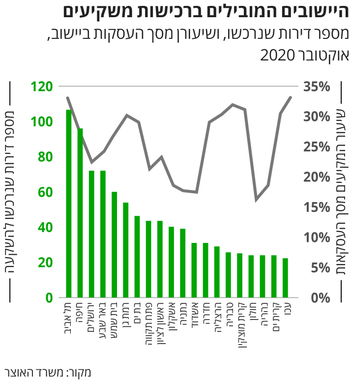
Anyone who has asked to buy a new apartment in recent months knows that the contractors have not really reduced prices. The subsidized apartments were a significant share of the market, and a large project of the program marketed in Beit Shemesh caused a decrease in the average price in the Jerusalem area. However, about 80% of the market is not subsidized - and its prices range from stability to moderate increases, which are expected to worsen in the coming months, despite the corona crisis.
These are the five reasons that may lead to a resurgence of prices in the housing market:
1. Collapse of subsidy plans
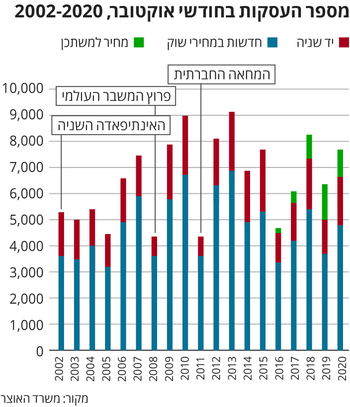
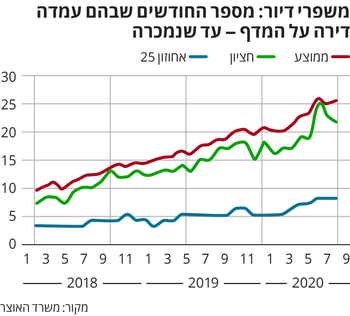
Government subsidy programs did not solve the problem of housing shortages, but managed to disguise the rise in prices in the free market: the relatively low prices of subsidized dwellings lowered the average prices in the market, and in periods when the rate of subsidized dwellings increased, average prices fell. The share of subsidized dwellings is still high - 36.6% - and is the decisive factor in the price differences between the new dwellings, which are affected by the plan, and second-hand dwellings.In the past year, the state has stopped marketing subsidized land. In the past week, the Ministry of Housing has been trying to start marketing the alternative program - housing at a reduced price - but its potential scope, at least in the coming year, is much smaller than that of the price per occupant.
2. Decrease in construction starts
It is estimated that construction starts have shrunk by 20% -10% this year,As a result of work disruptions in some construction companies, a shortage of workers and the state's failure to comply with the land marketing plan. The decline in land marketing is expected to have a greater impact on construction starts next year - and consequently on apartment marketing. Urban renewal programs were supposed to compensate for some of the decline in new land marketing, but even in this area the growth rate is extremely slow - and even weakened this year by local authorities struggling to adapt infrastructure development to the population growth programs (average demolition and construction program doubles the population) . Only in the last year has the state been prepared to offer realistic solutions to the infrastructure problem, but these are far from being implemented.
3. The return of investors
The last quarter of 2020 was marked by the return of investors to the housing market: the decision of the Minister of Finance, Israel Katz, to return the purchase tax to investors in apartments to its previous level - about 6% - is only part of the explanation. And emptied some of the office towers - caused many investors, who preferred to invest abroad or in office buildings in Israel, to recalculate their investment and return to the old and familiar: residential apartments in Israel. Real estate flows into the stock market and pumps up the shares of construction companies, as a substitute for direct investment in the apartment.
Increasing the prime interest rate share will also benefit investors, who will now be able to borrow cheaper money and even sell the apartment more quickly, as there is no early repayment fee on a prime interest rate loan.
4. Chaos in government management
The housing headquarters, which was the main instrument for coordinated promotion of the housing industry, was disbanded in the current government - and no replacement was found. The Minister of Construction and Housing, Yaakov Litzman, is one of the main drivers of the rise in apartment prices: Since his first appointment, Litzman has dealt mainly with political antics, dismissals and appointments within his office - and less with solving the industry's basic problems.He presented a controversial plan to subsidize small and cheap apartments in the periphery, designed primarily to help ultra-Orthodox couples, in parallel with a plan that is supposed to be a kind of pale sequel to a price-per-tenant plan. Both programs offer primarily to fuel demand for apartments, but neither offers increasing supply. Another program, supporting urban renewal through land marketing revenues, may increase supply, but even if successful it will only be felt in the market in a few years, due to the slowness of procedures in urban renewal programs.

5. The Bank of Israel in a discount campaign
Reducing the limit on low-interest loans increases the purchasing power of borrowers, as measured by the repayment capacity of larger loans. The psychological impact of the move on the housing market may be sharper than the measurable impact of additional purchasing power.In a market dominated by sellers, the increase in purchasing power is expected to translate into rising house prices.Another side of the Bank of Israel's policy is the deferral of mortgage repayments. The state will soon be forced to cancel, rather than gradually, the corona rebates: everyone, including mortgage holders, will have to repay the debt it has swelled. It is possible that some of today's prime escorts will increase the supply of apartments in the wake of the plague.