



Calcalist, Amitay Gazit, 24.11.2020
Finance Minister Israel Katz's refusal to sign a nearly three-month-old decision dramatically cuts the number of apartments for construction. The Calcalist survey shows that so far, in 2020, tenders were signed for the construction of only 10,000 apartments on the land of the Israel Land Authority (RMI). For comparison, in 2019 26,000 apartments were approved and in 2018 32,000 apartments were approved.
The corona crisis and the logistical challenges it poses to the construction industry are a partial explanation for the tender problem. But these challenges were overcome by Rami in the first closure. The real problem lies in the dispute between the Ministry of Finance and the Ministry of Construction, and that Katz has not yet signed the new marketing method that will replace the price per occupant, even though the Israel Land Council has already made a decision on September 3. Of Katz, the council's decision has no validity, and there is no legal way that will allow tenders to be closed according to the rules that returning Minister of Construction Yaakov Litzman seeks to implement.
This year, there was a dramatic drop of 50% in the number of apartments that can be built on land allocated to construction companies that won RMI tenders.monopolyManages over 90% of state land. The Calcalist survey shows that by November 2020, the Authority had signed contracts with construction companies that won a tender for the construction of about 10,000 apartments. In the corresponding period in 2019, transactions were signed in the amount of 21,000 apartments and by the end of 2019, the number had reached 26,000 apartments. In 2018, Rami signed transactions in tenders for the construction of 32,000 apartments, and a year earlier 35,000 apartments. These lands constitute about half of the land for residential construction in the demand areas.
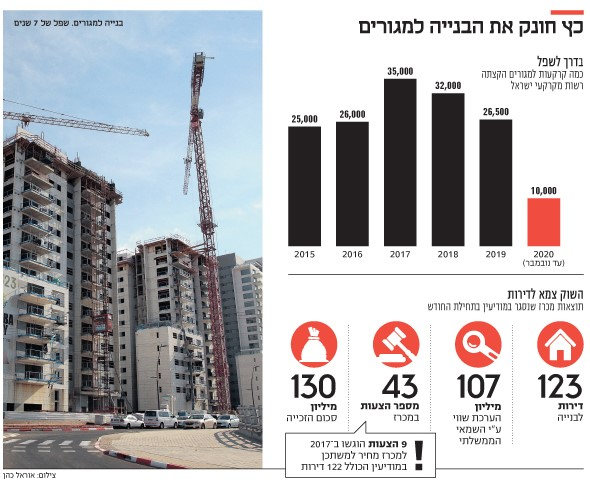
The test we conducted focused only on transactions for residential building land that were closed after a tender. We did not include transactions that were closed without a tender, because the root of the problem is the inability of the authority to close residential real estate tenders.
In recent years, Rami has also closed deals exempt from a tender to build about 10,000-12,000 apartments a year. Even if it stays at this pace this year, the situation is dismal. Even if this year the rate of transactions exempt from tender is maintained, 2020 will end with a total of transactions for the construction of only 22,000 apartments - the lowest figure since 2013, when land was allocated for the construction of 30,000 apartments in total. In 2014, land was allocated for the construction of a similar amount of apartments, and in 2016-2018, an average of land was allocated for the construction of about 40,000 apartments.
In any case, these are quantities that are very far from the target set by the government for Remi, for the marketing of land for the construction of 45,000-50,000 housing units each year.
On the other hand, the demand for home buyers has hardly fallen - and in recent months the pace of transactions has been at its peak despite the economic crisis. Only recently did the chief economist at the Treasury, Shira Greenberg, report that the Treasury was surprised by the high sales rate of apartments in September, in which 9,600 new and second-hand apartments were sold despite the closure and the Tishrei holidays.
Public real estate companies, which are currently publishing financial reports, also present record data on the sale of apartments. Yesterday, for example, YH Damari reported that it sold 499 apartments from January to September this year, compared to only 286 apartments in the corresponding period last year. According to the company, the sales rate did not decrease in October or November either, and so far 98 apartments have been sold in less than two months.
In light of this, the decline in supply seems to meet a strong and perhaps even increasing demand. This combination could herald further price increases in real estate, despite the rampage of the corona virus and double-digit unemployment rates.
Katz's strange behavior, government paralysis, lack of budget and a dispute between the Ministry of Construction Ministry of Finance did not allow to establish rules for tenders. In addition, without a state budget there is no source of funding for tenders that require grants and subsidies.
To illustrate the distress in which the industry finds itself, it is possible to examine a tender that closed at the beginning of the month for the construction of 123 apartments in Modi'in, one of the few tenders that have been published and closed recently. 43 different bids were submitted for the tender. This is a real onslaught, if you compare to a similar tender in its scope from 2017, to which only 9 bids were submitted. The winning company, Gilad May, purchased the land for NIS 130 million - in addition to NIS 17 million in development expenses - 23% more than the value of the land according to the government appraiser, which is worth about NIS 107 million.
Bottom line, this is a sharp slowdown in the residential construction industry - one of the engines of growth in the economy, whose annual output is about NIS 80 billion, about 6% of the State of Israel's GDP. A slowdown in the industry could add another weight to the economy, which is already in such a crisis.
The Treasury is seeking to reduce discounts
The troubling question is why Katz has been delaying a simple technical act like signing the council's decision for nearly three months. According to sources involved in the issue, the Ministry of Finance wants to reduce the discounts given by RMI to developers on apartments as well as the number of apartments that will be marketed at a discount, claiming that the discount mechanism causes unnecessary government intervention, complicates the procedure and harms the free market. , Because some of the winners enjoyed a discount of hundreds of thousands of shekels compared to market prices, while others settled for a much more modest discount.
But these allegations do not explain why Katz has been delayed for three months since the approval, certainly when one remembers that the talks between the Ministry of Finance and the Ministry of Construction on the subject began a long time ago. In addition, the principles of the new marketing method already address some of the issues raised by the Ministry of Finance regarding discounts.
Beyond the questions of principle, the fact that the budget department in particular and the top of the finance ministry in general have undergone personal upheavals and shocks in recent months certainly does not help to make professional decisions in the ministry. At the same time, the fact that Rami CEO Adiel Shimron announced his departure and a new CEO has not yet been elected does not help the atmosphere of urgency and pressure in the face of such low volumes of land marketing.
In the new method, the land will be divided into three regions. In the first area, which includes expensive neighborhoods where the price of a 100-square-meter apartment is 2.2 million or more, no discounts will be given and most of the price will win the tender. This mechanism will prevent huge discounts in areas that are not relevant to the middle class.
In areas where prices are lower, the new layout will provide discounts of NIS 250,000-400,000 per apartment. There, the state will pre-determine the price of land, construction companies will compete for a bid for the cheapest apartment price, and the state will set a minimum price and a maximum price, in a way that will limit the amount of discounts.
In the third area, in the far periphery, the tenders are supposed to include grants of NIS 40,000-60,000 for the buyers of the apartments and an additional NIS 40,000 as a subsidy to the contractors for the development of each apartment. To transfer the grants, the government needs to point to a budgetary source for funding and subsidizing development. But in the absence of a government budget, this source simply does not exist.
The Ministry of Finance and the Ministry of Construction have agreed that at least 50% of the apartments in each of the types of tenders will be sold on the free market without a discount.
Rami asks contractors to gamble
It seems that the Ministry of Construction has decided not to wait for the minister's signature - and last month ordered the Israel Land Authority to upload the tender brochures to the authority's websites. But the brochures we examined include a strange reservation that after the closing of the tender the winner may be asked to pay an additional unknown amount for the costs of developing the land. This reservation stems from the lack of agreements between the Ministry of Finance and the Ministry of Construction and is intended to avoid legal complications resulting from the fact that a state budget has not yet been approved and the subsidy for development expenses cannot be approved. In other words, Rami asks the people of the construction companies to gamble and commit to the price of an apartment when they do not know for sure what the price of the land is and what the development costs are.
The Ministry of Finance responded: "The issue is still under internal government work and final understandings have not yet been formed between the ministries."
The Ministry of Construction responded: "Minister Litzman's 'Reduced Price Housing' marketing plan was approved by the council in September. Details of the plan are awaiting approval from the Ministry of Finance and will be implemented in the field. We hope that this approval will be received as soon as possible." "We emphasize that the tenders will be closed only after there is certainty about the issue of the development subsidy and grants component. The update on the subject will be uploaded to the tender website within a reasonable time, as is customary in these matters."