



The Marker, Meirav Arlozorov, 04.11.2020
Purple is the favorite color of local government, and not just because of the purple character that allows for starting a business. In the world of planning, purple is the color of employment areas - income-producing real estate consisting of industrial areas, malls, office towers, etc. It is so endearing to local authorities that all of Israel's planning maps are studded with countless purple spots.
Israel currently has purple areas - in comprehensive or detailed plans - of more than 230 million square meters, while the total built-up employment area is about 45 million square meters, and the actual annual construction volume is about 1.7 million square meters. Elad alone recently approved an employment plan equivalent to the size of 21 Azrieli Towers, and the Ministry of Finance calculated and found that the reserves of employment areas in Israel will be sufficient until at least 2068.
The pursuit of purple areas - even if it is clear that there is an inconceivable surplus and therefore very few of them will actually be built at the end - stems from the terrible distortion of property taxes. The property tax is the largest and most important source of income for the local government, and it generates an average of about NIS 25 billion a year. About NIS 11 billion of this amount is property tax levied on residential apartments, and more than NIS 13 billion is collected as business property tax - from the same purple areas.
The distribution is almost half and half in terms of income from residential property tax versus business property tax, but in terms of economic value, the distribution is completely different. The average rate of residential property tax in Israel is NIS 51 per square meter (the approved range is NIS 36-124 per square meter).
It is estimated that on average the authorities lose about NIS 5,000 a year per housing unit. This explains why they refuse to approve residential construction plans
On the other hand, in business property taxes, the average is NIS 85 per square meter for workshops, NIS 185 per square meter for trade and about NIS 1,000 per square meter for banks and insurance companies. Almost does not require expenses from the authority - maximum garbage removal, and some preoccupation with business licensing.On the other hand, a resident is a very heavy consumer of education, welfare, leisure, religion, parks and more.
The cross-subsidy
The property tax suffers from heavy cross-subsidization - the business property tax is profitable and subsidizes the losses from the residential property tax in its profits. It is estimated that on average the authorities lose about NIS 1,500 a year per resident (about NIS 5,000 a year per housing unit), which explains why the authorities flock in droves to paint as many purple spots in their area as possible, and why they refuse to approve residential construction plans in their area. Who wants residents, when they lose thousands of shekels a year for every residential apartment?
This distortion is not new. It has been known to everyone since 1985, when the state froze property tax rates as part of the stabilization program to eradicate hyperinflation. Since then, for 35 years, property tax rates have not changed (except for linkage, according to an annual formula). Any authority that wants to raise or lower its property tax rates needs double approval - from the Minister of the Interior and the Minister of Finance - and the ministers in the various governments reject most of the requests, and especially the requests to increase the property tax.
The price of this distortion is charged to every citizen in Israel. The housing crisis , for example, is a consequence of the distortion of property taxes: authorities do not want to approve residential construction, and this is one of the explanations for the sharp jump in housing prices. Israel's huge social gaps and the terrible neglect of the poor cities of the ultra-Orthodox and the Arabs are also a consequence of this distortion.
In the latest OECD report on Israel, the organization devoted an entire chapter to the huge gaps between the authorities in Israel - the largest in developed countries. : Cities with large employment centers enjoy huge revenues.
 Business in the Corona period Photo: Ofer Vaknin
There is nothing like the corona crisis to illustrate the distortion in the collection per square meter, regardless of the value of the property and income, when hundreds of thousands of businesses were shut down
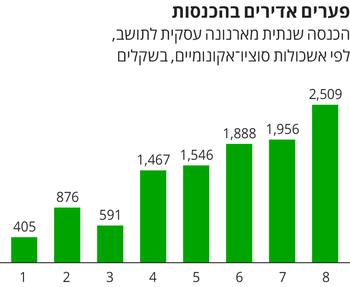
The income of business property tax per resident in the authorities in the socio-economic cluster 8 is six times higher than that of the authorities in the lowest socio-economic cluster. Because of the huge revenues, rich cities like Tel Aviv can lower the residential property tax rate. This is how a vicious circle is created: a city with a lot of business activity can provide its residents with much more services and charge them much less property taxes. In contrast, a city without much business activity does not provide services, and is also forced to collect more taxes from its poor residents.
In this way, the property tax is a tax that widens gaps, exacerbates the housing crisis, distorts the allocation of land planning in Israel, also destroys public transportation planning (how can public transportation lines be planned for employment areas, when there is such a huge surplus and it is impossible to predict where they will actually be built). Neutralizes the independence of local authorities and makes them dependent on the decisions of the central government, and also constitutes a millstone on business entrepreneurship.
Since the property tax is collected by the meter built, regardless of the value of the property or the profit of the business, it is a tax that suppresses business activity. There is nothing like the corona crisis to illustrate this: Hundreds of thousands of businesses in Israel found themselves disabled and without income, but with property tax debts. Only the intervention of the state and the freezing of the collection of property taxes for the period of the first closure, enabled them to deal with these debts.
The historical problems of property tax distortion have been exacerbated during the corona crisis. First, it was revealed how much the property tax weighs on businesses and suppresses activity. Second, the crisis exposed the bluff of the purple spots. If before the corona there was an excess of purple spots for decades, then in the post-corona era it is clear that most of them will never be built.
In fact, even employment areas that have already been built are likely to generate much less revenue for local authorities, and may not generate revenue at all. The move to work from home and online orders is expected to dramatically reduce the demand for office space and commercial space. In doing so, the distortion of the cross-subsidization between business and residential property taxes is likely to explode in the face of the state: local government will no longer have business revenues through which it will be possible to finance deficit services for residents. The distortion is expected to collapse into itself.
After 35 years in which the state has been dragging its feet in resolving property tax distortions , the corona crisis may leave no choice but to tackle the problem. The solution is clear: residential property taxes must be raised so that residents cease to be in deficit. It makes sense to make a connection between the value of the apartmentand the property tax that is imposed on it, and not just charge a price per meter. But raising property taxes is an unpopular move, and politicians - both ministers and mayors - will find it difficult to do so.
Therefore, there are also some intermediate proposals: one of them is the division of business property tax receipts between strong cities and weak cities (very common in the world, but may hurt the incentive to develop business areas by strong authorities); Another proposal is to introduce business property tax collection at the regional level, while residential property tax will continue to be collected by each authority; And there are even proposals that the state collect the property tax, in addition to VAT, and distribute it among the local authorities (a model that also exists in the world).
In any case, it is clear that the existing distortion must not continue, and certainly it is impossible to continue with the absurd freeze on property tax rates since 1985, including the complete dependence of local authorities' revenues on the decisions of the Minister of the Interior and the Minister of Finance. The corona is a crisis that does a great job of exposing bluffs, and maybe that's a good thing.