



Calcalist, Shlomit Tzur, 26.10.20
Much like in the days when former Finance Minister Moshe Kahlon transferred all powers related to housing, this time Interior Ministry Director General Mordechai Cohen finds himself holding almost all key positions related to planning and construction in Israel, including infrastructure and transportation. Cohen also serves as Interior Ministry director under him The Planning Administration is also the chairman of the National Planning and Building Council (replacing Zeev Bielski) and the chairman of the National Infrastructure Committee, which currently leads the country's major infrastructure and transportation projects such as the metro. Half a year after the Planning Administration was returned from the Ministry of Finance to the Interior Ministry, Cohen announces that the state of emergency in the housing market has ended, the "emergency room" has closed, and now is the time to return to balance and even "slow down construction in some places."
"There was a housing crisis, and it was right to act aggressively to produce planning stock," Cohen explains, "but today, there is nothing better than planning institutions returning to the Interior Ministry, and everyone understands that. Under the Interior Ministry a plan is not just housing. Until now Rushed for housing solutions, which created a suburb, abandonment of city centers, damage to open spaces, and industrial areas that approved unconsciously.
"We have been constantly warned of the economic consequences of adding a mass of apartments in cities, and today we know that some of the 59 authorities that went into the process of accelerated housing will have a hard time surviving financially. "This state of emergency has ceased and it is good that it has. Five years have created planning stock and now we need to return to a revised policy, which also takes into account the ability of each authority to carry out the realization of the approved planning stock."
The authorities' difficulty in surviving, which Cohen is talking about, was revealed last week in "Calcalist" with the publication of a report by the Ministry of the Interior that for the first time quantified the number of authorities that would run into difficulties due to accelerated construction under umbrella agreements signed by the authorities.
Do you think that all the approved employment areas will not be inhabited, even in the long run?
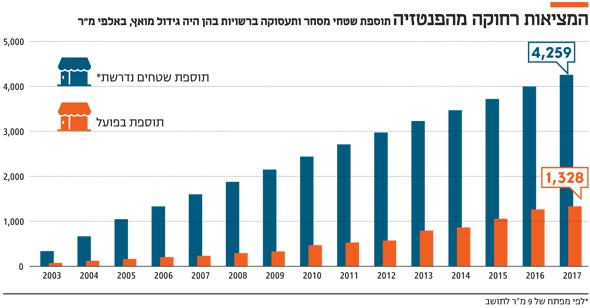
"There was a real obsession with painting areas in purple (employment areas) to justify the approved living areas. There is no chance in the world that all these employment areas will be built. It would not happen, even without the corona, because they were not created out of necessity. To give a technical answer to the balance of property taxes. A move that goes against all basic planning logic. Today everyone admits it, and now all the players - the Ministry of Finance and the Planning Administration - are stressed, convening intensive discussions on how to produce a solution. And Haifa and Jerusalem will be stronger and become a metropolis, we will part with the reality of the state of Tel Aviv. And this is what Interior Minister Aryeh Deri strives for. Blood must flow to all organs, and not just a state whose economic heart is Tel Aviv. "Mechanisms that will not be needed. Today everything happens in zooms and emails. Everything is simpler. Why do we need so many authorities?"
One of the reasons for the transfer of the Planning Administration from the Ministry of the Interior to the Ministry of Finance was the budget issue. Entire plans were approved without any infrastructure budget. In the Ministry of Finance at least this issue was supposed to be resolved.
"Is it right to put every field under the Ministry of Finance because of the budget? The answer is no. It also does not guarantee that the budget problem will be solved, so it is not an advantage in itself. "No. Such an idea in Europe would have been thrown off all the stairs."
"The corona has shown that there is a price to pay"
So if you go back to normalization in planning, how do you explain that you continue with the OTMAL which is a symbol of extremism in the scope of planning?
"Because it is irresponsible for a second extreme. It is impossible to move from the reality of WTAML (National Committee for the Planning and Construction of Preferred Housing Complexes) to a situation where there is nothing. A dramatic principle that will guide us will be phases, and we will not hesitate to slow down where necessary. Additional emphasis will be on urban renewal which today is unreasonably behind, and requires root canal treatment. We have a tremendous opportunity, 70 years since the establishment of the state, to demolish housing estates and build new buildings in evacuation construction.
"Another emphasis in BOTAML will be on maintaining open spaces. Until recently, the weight of OTMAL was the approval of plans for open spaces - the easiest solution. Now we will return to balance. "And the Arab society - which had no solution in the USSR, and the corona proved it. The corona is a shocking show, which shows that there is a price for neglect. Entire neighborhoods that live in overcrowding and poverty. The planning that was done did not close the gap."
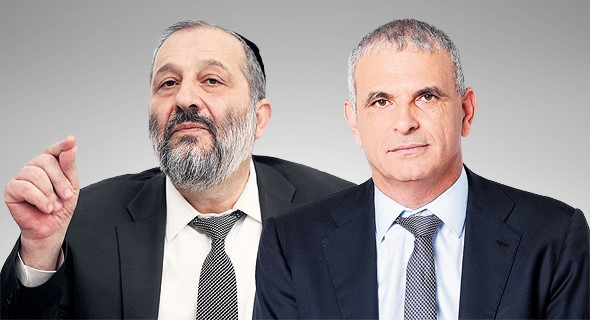 Right: Former Finance Minister Moshe Kahlon and Interior Minister Aryeh Deri Photos: Dana Kopel, Amit Shabi
Everyone has forgotten the new ultra-Orthodox city of Kasif, which will be advanced near Arad.
"Silver is not the right solution. It is still on the table, but it is not right to produce a homogeneous city, a city should be heterogeneous. It is easiest to build on vacant land a city with a certain character but cities need to be diverse and this will be achieved through a mix."
Former Minister of Housing Ariel Atias said that separate cities should be built for the ultra-Orthodox and the secular, because the construction is different and the populations do not really want to live side by side.
"Atias was wrong in this matter. Look at Ashdod - a city planned for both secular and ultra-Orthodox population, and the two populations live excellently with each other. A city with a hospital, a beach, and challenges it faces well. And yes, I know it will not be easy "Because when you work in balance, neither side is happy."
The government has indeed neglected the ultra-Orthodox public, but the ultra-Orthodox leaders also have a contribution to make to the situation. They ruled that the Shabbat elevator could not be used - which to this day prevents them from building to heights and forces them to live in overcrowding.
"I do not agree with that. Why not come up with complaints to communities in the rural sector, for example, who want to live only on land and refuse to approve plans for saturated construction because it contradicts their worldview? What's the difference? Only no one spits venom and poison on them because they are perceived as liberal And advanced - although land-based have no more place in the planning discourse when the land resource is limited.
"So with the ultra-Orthodox, the non-use of the Shabbat elevator is no different. Every community in Israel brings constraints and must be dealt with within a reasonable limit. Our job is not to interfere with cultural or community preferences, but to create solutions. ".
"My Temporary Excess Power"
"The metro plan," Cohen adds, "which is the largest transportation event since the establishment of the state, is an example of the problem of dealing with the ultra-Orthodox. In Bnei Brak, is it conceivable that government institutions would consider such a wrong consideration, so much so that the public that needs it most and needs public transportation most intensively will not get a metro station, and all this out of 'consideration'? A huge outcry has arisen, "Rabbi Hotal (Committee for National Infrastructures), and when the approval of the metro route comes to my table, I will make sure that the alternative that passes in Bnei Brak is the alternative that will be approved.
Don't you think that you have too many powers? Director General of the Ministry of the Interior, Chairman of the National Council and also Chairman of the Hotal.
"This is temporary. A limited planning staff will be established, and the head of the planning staff will be both the chairman of the national council and the chairman of the Hotal. The policy will not change. Our perception is that a mayor is not a nuisance. But represents a public elected on a direct note, and must hear it. I insist these days that mayors come to discussions in the National Council that determines what construction will look like. On the other hand, it is inevitable that the Hotal, where decisions are made on large infrastructure, is the one who will set the tone and decide and not the mayors. Because there is a clear conflict of interest between the need for a national infrastructure The Israeli government is the most centralized of all the OECD countriesand there is no escape from the transfer of powers from the central government to the local one. "
But a mayor can also be an incompetent person, lacking knowledge and experience. Is it right to give him powers that were until now in the power of the government?
"Threshold conditions must not be set for elected officials. An elected official is supposed to represent and lead according to his worldview. That is the principle in a democracy. Indeed, we do not distribute powers to everyone equally. But in a controlled way, according to the ability to absorb abilities and powers. Strictly.If we were operating in a differential method, the whole crisis management would have been easier.No mayor wants his city to be red.
"Years have missed the most important debate - the tension between the central and local government. Suddenly everyone is discussing what should be in the authority of the government and what in the municipality. It does not make sense for the government to manage everything that happens in the local authority.
"Like in education, the government will set rules, and each authority will decide which ages return from quarantine, yes or no capsules, and which buildings are suitable. There will be an authority with kindergartens that work, and an authority that does not. This is how it works in the Netherlands and Denmark. Could not carry out the studies in the localities themselves? After all, every locality is a capsule. There was no flexibility. For example, I am 100% convinced that a local authority has a clear advantage in more correct planning of transportation in its field compared to any other planning institution. Who live in Jerusalem, but from someone who lives in the city and knows it. "
"Employment should be in the area of residence"
In Kfar Saba, where you live, in Hod Hasharon and in the Southern Sharon Council, the heads of the authorities and residents oppose the construction of the metro depot.
"In terms of the statutory situation, most of the metro plans have already been submitted for objections, except for the northern part of the M1 route . In the background there is a local authorities' demand to find an alternative location for depot. We have a duty to choose the best alternative to Depot that serves the public interest. "
What will the employment areas look like in the future?
"Reality requires us to think differently about them. Technology is changing reality, trade has moved online, and there will be no need for so much space. We may reach a situation where planned employment areas are reduced, through construction phases. In stages, it was determined that no planning would be promoted if there was no mix. We are short of NIS 1.5 billion to balance these authorities. And they have to come either from a government budget, or from a slowdown in the addition of housing, or from the production of income. "